
New to funded trading?
ExploreUS traders face a smaller menu than most. Many well-known prop firms restrict or block clients based in the United States, usually because offering leveraged forex and CFDs to US retail traders runs into US derivatives regulation. So a firm that looks perfect on paper often turns you away at signup, or worse, at payout. The firms that genuinely work for US traders cluster into three groups: multi-asset firms that accept US clients, US-based futures firms that operate on regulated exchanges, and crypto prop firms whose model sits outside the forex-CFD rules entirely.
This guide covers which firms actually accept US traders in 2026, what each is best for, and the specific things a US trader should verify before paying a challenge fee. For the wider field beyond US-friendly picks, see our roundup of the best prop firms. Trading from elsewhere? See our guides to prop firms in the UK, Australia and Canada. The single most important check is boring but decisive: confirm the firm accepts US clients and can pay you, before you spend a cent.
Highlights of this article
- Many forex and CFD prop firms restrict US clients; the reliable routes for US traders are multi-asset, futures, and crypto firms
- Velotrade accepts US traders with no country restriction, across crypto, forex, indices, stocks, and commodities on one funded account
- US-based futures firms (like Apex and Topstep) are a strong fit if you only trade futures on US exchanges
- Crypto prop firms sit outside the off-exchange forex rules, so US crypto traders usually have the widest choice
- Always confirm three things before paying: US eligibility, a payout method that works for you, and the drawdown model
Why US Traders Have Fewer Prop Firm Options
The restriction is not about your skill or your account size. It is about how the firm is set up. Offering off-exchange leveraged forex and CFDs to US retail clients falls under US derivatives rules overseen by the CFTC and NFA, and most offshore prop firms simply do not want that exposure. Rather than register, they exclude US clients from their forex and CFD products. That is why a US trader can pass a challenge elsewhere and then hit a wall at verification or withdrawal.
Three types of firm avoid that wall:
- Multi-asset firms that accept US clients. These run a challenge model across several asset classes and do not exclude the US. You get forex, indices, stocks, commodities, and crypto in one place. Velotrade is in this group.
- US-based futures firms. Trading futures on regulated US exchanges (the CME group) is a different legal path. Firms like Apex Trader Funding and Topstep are US companies built specifically for this, so US traders are their core audience.
- Crypto prop firms. Crypto derivatives are not off-exchange retail forex, so crypto-focused firms generally have the fewest US restrictions of all.
Knowing which group fits your strategy is most of the decision. The rest is comparing conditions.



Best Prop Firms for US Traders
1) Velotrade, best multi-asset firm for US traders
HQ: Hong Kong
Platform: DXtrade (plus REST and WebSocket API)
Accepts US traders: Yes, no country restriction
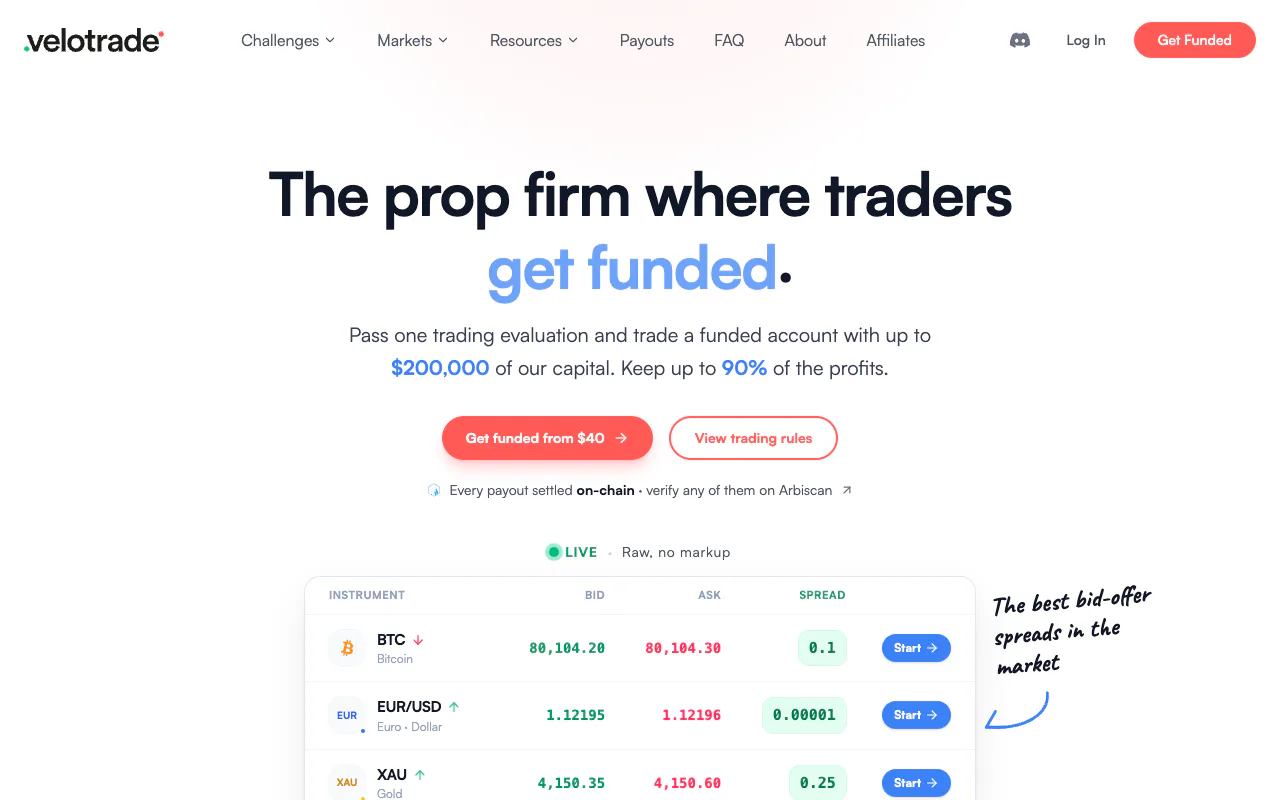
Velotrade accepts US traders with no country restriction, and it is multi-asset: you can trade crypto, forex, indices, stocks, and commodities on a single funded account rather than being boxed into one instrument. For a US trader who wants breadth without juggling several firms, that is the standout feature.
The conditions are trader-friendly in the ways that matter for US strategies:
- Static drawdown. Every challenge uses a static maximum drawdown: the loss floor is fixed from your starting balance and never trails your equity up. You always know exactly where your line is, which suits the volatility of US index and crypto sessions.
- No consistency rule, news trading allowed, weekend holding allowed. You are not penalized for a good day, and you can trade the US economic calendar, which matters if you trade around CPI, FOMC, or earnings.
- 80% profit split, or 90% with the paid add-on from your first payout, with no time-based scaling to unlock it.
- No cap on risk per trade and no max lot size; your only sizing limit is the static drawdown.
- On-demand crypto payouts, which sidestep the cross-border bank friction US traders often hit with offshore firms.
Account sizes run from $5,000 to $200,000, and the PRO 1-Step evaluation starts at $40. Platform is DXtrade. Full detail in the Velotrade review.
2) Apex Trader Funding, best for US futures traders
HQ: Austin, Texas
Platform: Tradovate, NinjaTrader
Accepts US traders: Yes, US company and core market
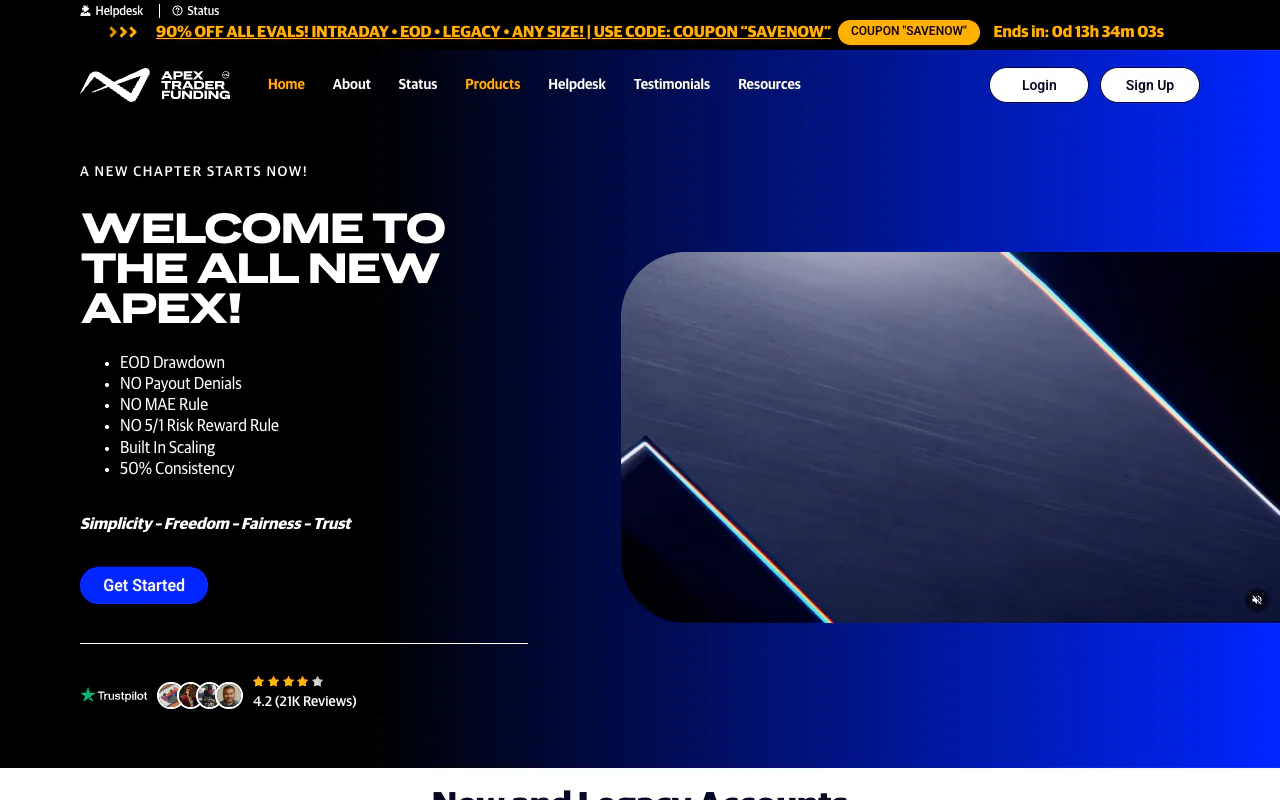
If you trade only futures, a US-based futures firm is the natural home. Apex Trader Funding is built around US futures on the CME exchanges, with a one-step evaluation and a large menu of account sizes. It is a US company, so US traders are its core market, not an exception it tolerates. The trade-off is scope: you are trading futures, not a multi-asset book. See the Apex Trader Funding review for the current rules, drawdown model, and the subscription structure.
3) Topstep, best-known US futures alternative

HQ: Chicago
Platform: TopstepX
Accepts US traders: Yes, US-based futures firm
Topstep is the other well-established US futures name, with a long track record and a strong reputation for actually paying. Like Apex, it is futures-only and US-based, so it fits a US trader who has settled on futures as their instrument. If you are weighing the two, the Topstep review covers its evaluation structure and rules in detail. A newer, cheaper futures alternative is Lucid Trading, which uses an end-of-day drawdown and a flat 90% split; see Lucid Trading vs Velotrade for how it compares.
4) HyroTrader, best for US crypto-native traders
HQ: Bratislava, Slovakia
Platform: CLEO (Bybit and Binance)
Accepts US traders: Yes, crypto-native firm
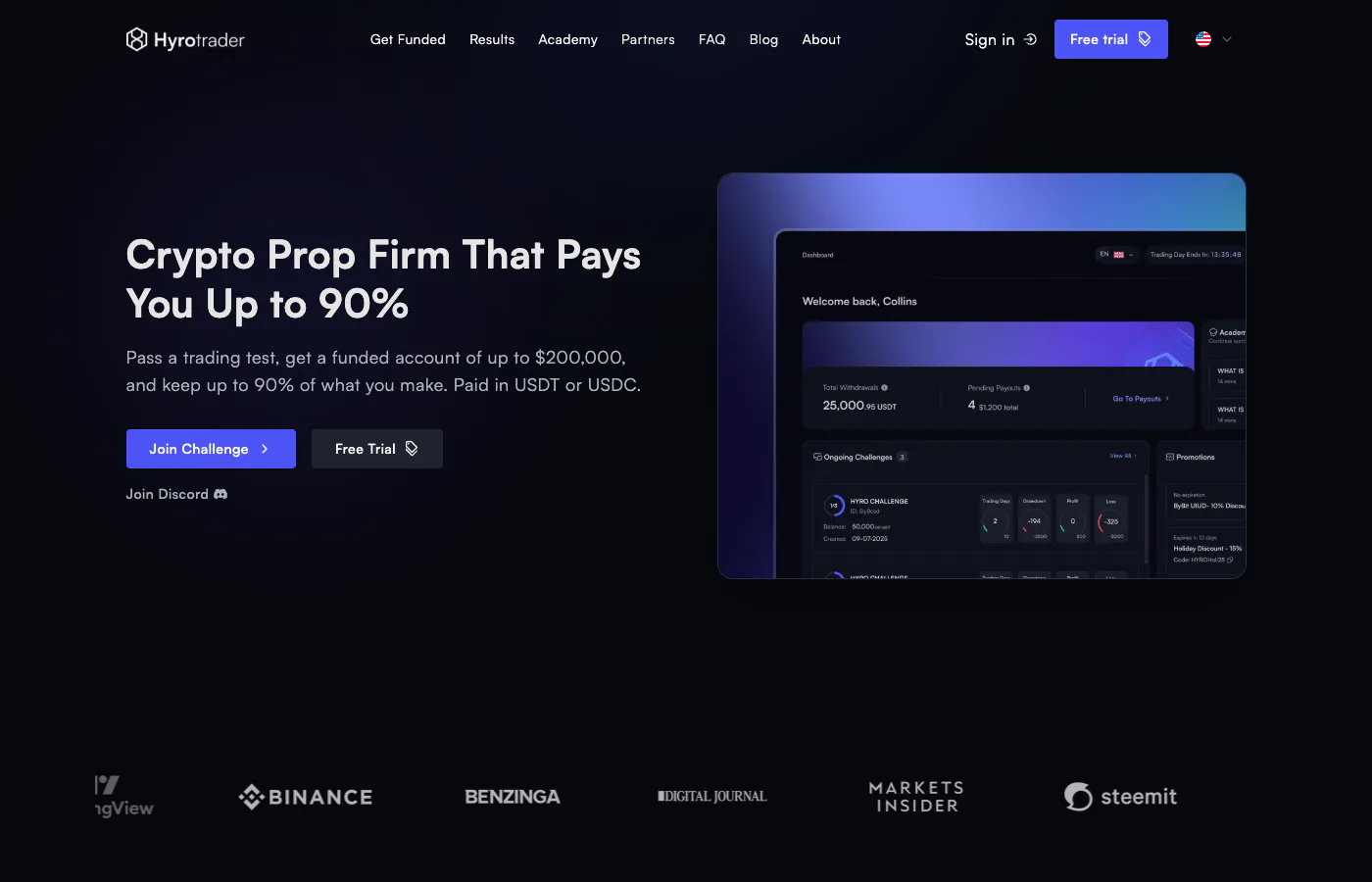
If your edge is purely in crypto, a crypto-native firm keeps you closest to your market. HyroTrader is crypto-focused and trades on a familiar crypto-exchange interface, which crypto traders often prefer over a generic CFD platform. It is narrower than Velotrade by design (crypto only), so it suits a trader who does not need forex, indices, or stocks. The HyroTrader review has the full breakdown, and the HyroTrader vs Velotrade comparison is worth reading if you are deciding between crypto-only and multi-asset.
Comparison Table
| Firm | Best for US traders who | Assets | Drawdown | Profit split |
|---|---|---|---|---|
| Velotrade | want multi-asset breadth on one account | Crypto, FX, indices, stocks, commodities | Static | 80%, or 90% with add-on |
| Apex Trader Funding | trade only futures | US futures (CME) | See review | High, per current terms |
| Topstep | want an established futures name | US futures (CME) | See review | High, per current terms |
| HyroTrader | trade only crypto | Crypto | See review | High, per current terms |
Conditions change, so treat this as a starting point and confirm the live numbers on each firm's site before you buy.
How to Choose: What Kind of US Trader Are You?
- You trade several markets, or want to. A multi-asset firm that accepts US clients is the efficient choice: one challenge, one funded account, crypto through to commodities. Velotrade is built for this.
- You are a dedicated futures trader. A US-based futures firm on the CME exchanges (Apex, Topstep, or newer names like Lucid) is purpose-built for you and keeps everything on regulated US infrastructure. See the best prop firm for futures roundup to compare them.
- You live in crypto. A crypto prop firm gives you the widest US access and a native trading interface. Velotrade covers crypto too if you also want the option to branch out later. See our best crypto prop firms guide for the ranked field.
- You are cost-sensitive. Compare the actual challenge fee for the account size you want, not the headline. A cheap 1-step with a tight drawdown can cost more in retries than a slightly pricier evaluation you pass once.
What US Traders Should Check Before Paying

- US eligibility, in writing. Check the terms for a restricted-countries list. If the United States is excluded from the product you want (often the forex or CFD product), do not buy, even if the crypto product is open.
- A payout method that works for you. Confirm how you will actually get paid. Crypto payouts (as Velotrade uses) avoid a lot of cross-border bank friction; bank-wire-only firms can be slower or problematic for US clients.
- The drawdown model. A static drawdown gives you a fixed floor you can plan around. A trailing drawdown moves up with your equity and can breach you on a normal pullback after a good run.
- Instrument access for your strategy. Make sure the assets and sessions you actually trade (US indices, crypto, metals) are available on the platform, not just listed in marketing.
- Rules that fit how you trade. News trading, weekend holding, consistency rules, and per-trade risk caps decide whether your real strategy is even allowed.
On the tax side, prop-firm payouts to US residents are generally treated as income, but how you report them depends on your situation. This is not tax advice; talk to a qualified US tax professional about your own case.
Last updated: August 2026. Prop firm rules, fees, and country eligibility change regularly. Confirm the current terms directly with each firm before purchasing a challenge.
Related reading: Best Crypto Prop Firms for Asian Traders in 2026.
Frequently Asked Questions
About the author

Vittorio De Angelis
Executive Chairman
Former equity-derivatives trader at JP Morgan, Dresdner Kleinwort and Bank of America in London. Later Head of Brokerage at a global broker in Hong Kong.
Velotrade was founded in Hong Kong in 2016 by a team from JP Morgan, Dresdner Kleinwort and Bank of America, has paid out over $2.5 billion to its trade-finance clients, and has been featured in Bloomberg, the Financial Times, the Wall Street Journal and on Nasdaq. Its prop trading evaluations are simulated and educational.
View author page