
Run your algo on funded capital
ExploreAI trading has become a catch-all term for everything from a simple rule-based script to a machine-learning model to asking ChatGPT to write your strategy. Most of the hype is noise, but underneath it is something real and now genuinely accessible: you can build a trading bot yourself, use an AI assistant to write most of the code, and run it on real capital. This guide separates what AI trading actually is from the marketing, walks through how to build your own bot, and covers the part almost every other guide skips: where you are actually allowed to run one.
The honest headline first: AI does not give you an edge. It speeds up the work of building, testing, and running a strategy you already believe in. If you understand that, the tooling below turns a months-long project into a weekend one.
Highlights of this article
- "AI trading" covers three different things: rule-based algorithms, machine-learning models, and using AI assistants (like ChatGPT or Claude) to help build a bot
- You do not need to be an expert coder anymore. An AI assistant can write most of a bot in Python if you can describe the strategy clearly
- The hard part is not the code, it is having a real edge and honest backtesting. AI cannot manufacture either
- To run a bot you need a broker or firm that allows automation and exposes an API. Most prop firms restrict bots; Velotrade does not
- Velotrade ships a downloadable AI Knowledge Base you can drop into a ChatGPT or Claude project to build directly against its trading API
What Is AI Trading?
There is no single definition, which is why the term is so slippery. In practice, "AI trading" means one of three things, and they are very different in what they require of you.
1. Rule-based algorithmic trading. A bot that follows explicit rules you define: buy when the 50-period moving average crosses the 200, size the position at 1% risk, exit at a fixed stop. There is no "AI" in the machine-learning sense here, it is deterministic code. This is algorithmic trading, and it is where most successful retail bots actually live.
2. Machine-learning models. A model trained on historical data to predict a price move, classify a regime, or size a position. This is the "AI" people usually picture. It is powerful and also where most retail attempts fail, because markets are noisy, non-stationary, and unforgiving of overfitting.
3. AI-assisted development. Using a large language model (ChatGPT, Claude) to help you write, debug, and iterate on the bot itself. This is the flavour that has changed the game for individuals, because it collapses the coding barrier without pretending to find an edge for you.
Most practical "build your own AI trading bot" projects in 2026 are a rule-based or lightly-ML strategy, built with heavy help from an AI assistant. That is the combination this guide focuses on.
Types of AI Trading Bots
Before you build, know which kind you are building, because it changes everything downstream:
- Signal bots generate alerts but do not execute. Lowest risk, lowest reward, a good first step. See AI trading signals for how these work.
- Execution bots place and manage orders automatically through a broker API. This is a "real" trading bot and what most people mean.
- Portfolio or allocation bots manage exposure across several instruments or strategies at once.
For a first project, an execution bot running a single, well-understood strategy on one or two instruments is the right scope. Ambition kills more bots than bugs do.
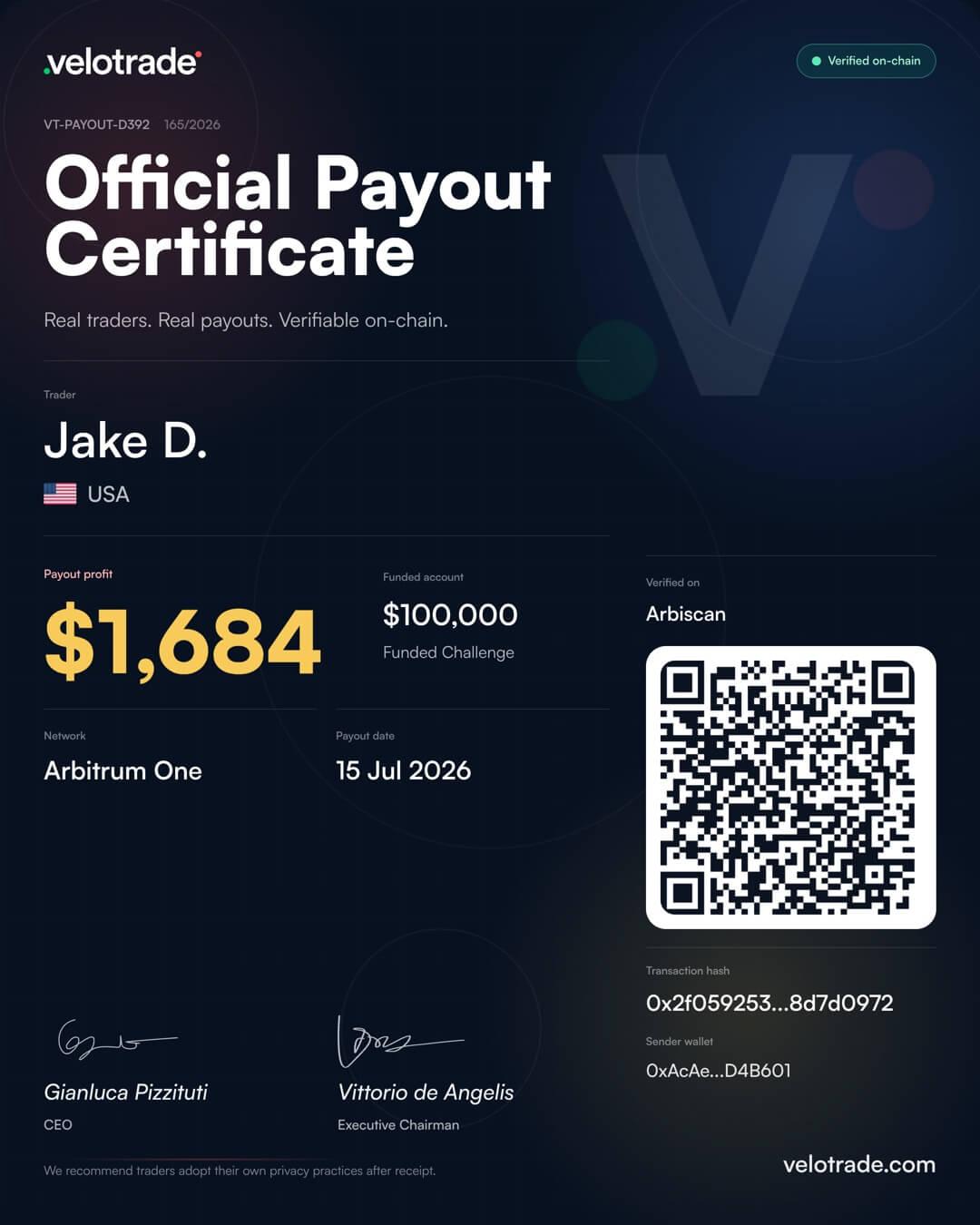
Payout proof
Fast, real payouts. Traceable on Arbitrum.
- Paid within 24 hours of approval
- Settled on Arbitrum in USDC or USDT
- Look up any transaction on Arbiscan

What You Need to Build an AI Trading Bot
Five things, in order of importance:
- A real strategy with an edge. A rule set you can state precisely and have reason to believe works. This is the only part AI cannot give you.
- A language, almost always Python. Its data and trading libraries are unmatched, and every AI assistant writes it fluently.
- Market data. Historical data to backtest and live data to trade. Your broker's API usually provides the live feed.
- An execution API. A programmatic connection to a broker or firm that lets your code place orders. This is the piece that decides where you can actually run the bot (more below).
- A backtesting and risk framework. A way to test the strategy on history honestly, and hard limits so a bug cannot blow up the account.
How to Build Your Own AI Trading Bot, Step by Step
Step 1: Define the strategy in plain language. Write the exact rules for entry, exit, position size, and risk before you write any code. If you cannot state them in a paragraph, you are not ready to automate them.
Step 2: Get data and an execution API. Pull historical data to test against, and choose where the bot will trade. You need an API that lets code authenticate, read market data, and place orders. A full REST and WebSocket API is ideal because it covers both order placement and live streaming.
Step 3: Write the bot, with an AI assistant. This is where 2026 differs from a few years ago. Describe your strategy and your API to ChatGPT or Claude, and let it draft the connection code, the strategy logic, and the order handling. You review, test, and correct, but you are editing, not writing from scratch. See how to build a trading bot for the step-by-step code walkthrough.
Step 4: Backtest honestly. Run the strategy over historical data and be ruthless about the traps: lookahead bias, survivorship bias, over-fitting to the test set, and ignoring costs. Backtesting a strategy properly is what separates a real edge from a curve fit.
Step 5: Paper trade, then go live small. Run the bot on simulated or tiny live size first. Watch how it behaves with real fills, latency, and slippage, none of which show up in a backtest. Only scale once it behaves as expected.
Step 6: Run it on capital that allows bots. A working bot is useless if your broker bans automation. The last section covers this, because it is where most people get stuck.
Building a Bot With ChatGPT or Claude
The single biggest change for individual traders is that an AI assistant can now write most of a trading bot. Describe the strategy and hand it the API documentation, and it will produce working code you refine rather than author.
The catch is that the assistant needs to know your API. Generic help gets you generic code; accurate help needs the real endpoints, authentication flow, and message formats. That is exactly why Velotrade publishes a downloadable AI Knowledge Base: a package you drop into a ChatGPT or Claude project so the assistant can build directly against Velotrade's trading API, with the correct login flow, REST calls, and WebSocket subscriptions. It is read-only by default and ships with no credentials, so you can prototype safely.
Used well, the workflow is: load the knowledge base, describe your strategy, get a working bot, backtest it, and deploy. What the assistant does not do, and cannot, is invent an edge. Keep that line clear and the tool is genuinely powerful.
Free download
Build faster with the AI Knowledge Base
Everything on this page as a portable package. Drop it into a ChatGPT or Claude project and let the assistant build against the Velotrade API with you. Read-only by default, no credentials included.
Download the AI Knowledge BaseWhere to Run an AI Trading Bot
This is the question most guides skip, and it is the one that stops people. To run a bot you need somewhere that (a) allows automated trading, (b) exposes a real API, and (c) ideally gives you capital to trade beyond your own.
Most prop firms fail at least one of these. Many ban expert advisors and bots outright, cap automated behaviour, add a consistency rule that penalises the uneven returns a systematic strategy naturally produces, or gate API access behind extra fees. That is a poor fit for anyone building their own bot.
Velotrade is built the opposite way, which is why algo traders gravitate to it:
- A full REST and WebSocket API on every account, at no extra cost, for both order placement and live data.
- Automation allowed: expert advisors, custom bots, and copy-trading are all permitted within the standard risk limits.
- No consistency rule and no per-trade risk cap, so a systematic edge is not punished for being lumpy.
- Static drawdown, a fixed loss floor your code can be designed around rather than a moving target.
- Multi-asset on one account (crypto, forex, stocks, indices, commodities) and open to US traders, since it runs on DXtrade rather than MT-only rails.
The practical path is: build and test your bot, take a challenge to get a funded account, and run the bot on Velotrade's capital. For the wider landscape, see the best crypto prop firms for algo traders and the API access guide.
Is AI Trading Legit? A Reality Check
Yes and no, and the distinction matters. Building your own bot to execute a strategy you understand is completely legitimate, it is just automation. What is not legitimate is the wave of products promising a "profitable AI trading robot" or guaranteed returns. No honest bot guarantees profit, most retail bots lose money, and any service promising otherwise is a red flag.
Treat AI as what it is: a tool that removes the coding barrier and speeds up testing. The edge, the risk management, and the discipline still have to come from you. If you keep expectations grounded, AI trading is not a scam or a magic money machine, it is simply a faster way to build and run the strategy you were going to trade anyway. For the systematic side of this discipline, the quant trading guide goes deeper.
Funded accounts
Ready to get funded?
Trade up to $200,000 in firm capital with static drawdown, no consistency rule, and payouts within 24 hours. Pass the challenge and keep up to 90% of your profits.
Get funded from $40Last updated: August 2026. Tooling and platform terms change; confirm current API and account details on Velotrade's own pages before building.
Frequently Asked Questions
About the author

Vittorio De Angelis
Executive Chairman
Former equity-derivatives trader at JP Morgan, Dresdner Kleinwort and Bank of America in London. Later Head of Brokerage at a global broker in Hong Kong.
View author page