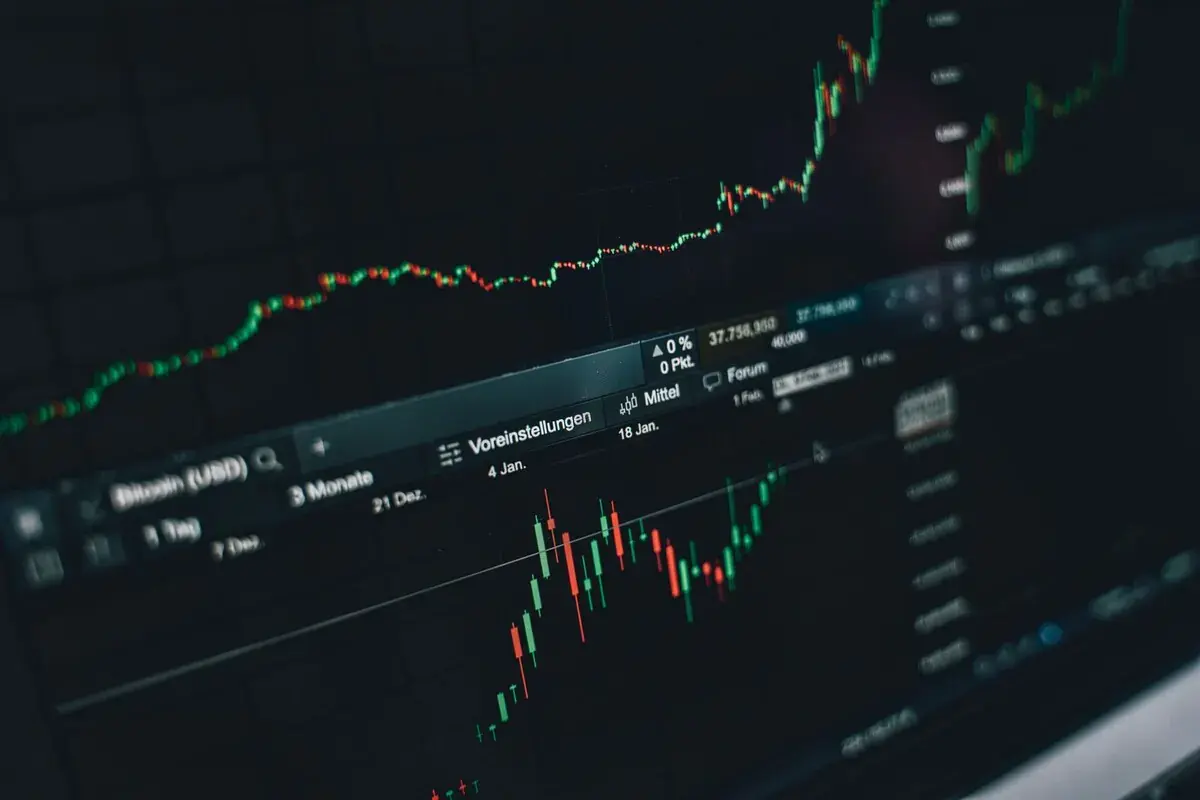
Run your algo on funded capital
ExploreAlgorithmic trading is the use of computer code to place orders in a market automatically, based on a fixed set of rules. Instead of clicking buy and sell by hand, you define the conditions once and the software watches the market and acts the moment those conditions are met. This guide explains what algorithmic trading is, how it works, and how to run a tested strategy on a funded account.
Highlights of this article
- Algorithmic trading turns a written rule set into code that executes orders without manual input.
- The main types include trend, mean reversion, arbitrage, market making, and execution algorithms.
- A strategy needs data, entry and exit rules, risk limits, and a connection to the market through an API.
- You do not need a computer science degree, but you do need clear rules and honest testing.
- Most prop firms restrict bots, so where you deploy matters as much as the code itself.
What algorithmic trading actually means
Algorithmic trading means handing your trading decisions to a program. You write down a rule, for example "buy when the 50 period moving average crosses above the 200 period average" (the classic golden cross), and turn that rule into code. The program then reads live prices, checks the condition, and sends the order to the market on its own.
The value is speed and consistency. A machine does not get bored, does not chase a loss, and does not skip a signal because it is 3am. It follows the same logic on trade number 1 and trade number 4,000. This removes the emotional mistakes that cost most discretionary traders money.
Algorithmic trading is not a guaranteed profit machine. A bad rule set loses money faster and more reliably than a human would. The edge comes from the quality of the strategy, not the automation itself. Automation only makes a good rule scalable and a bad rule expensive.
The field sits under the broader discipline of quant trading, where strategies are built and validated with data and statistics. Algorithmic trading is the execution layer of that discipline: the part that takes a researched idea and runs it in the live market.
How algorithmic trading works, step by step
Understanding how algorithmic trading works is easier when you break it into stages. Every automated system, from a simple script to a hedge fund engine, follows the same 5 steps.
- Data intake. The program pulls live and historical prices, volume, and sometimes order book depth.
- Signal logic. It runs the numbers through your rules to decide if the current moment is a buy, a sell, or a wait.
- Risk check. Before any order goes out, the code confirms position size, stop distance, and exposure limits.
- Order execution. It sends the order to the market through an API and records the fill.
- Monitoring. It tracks open positions and manages exits, then loops back to step 1.
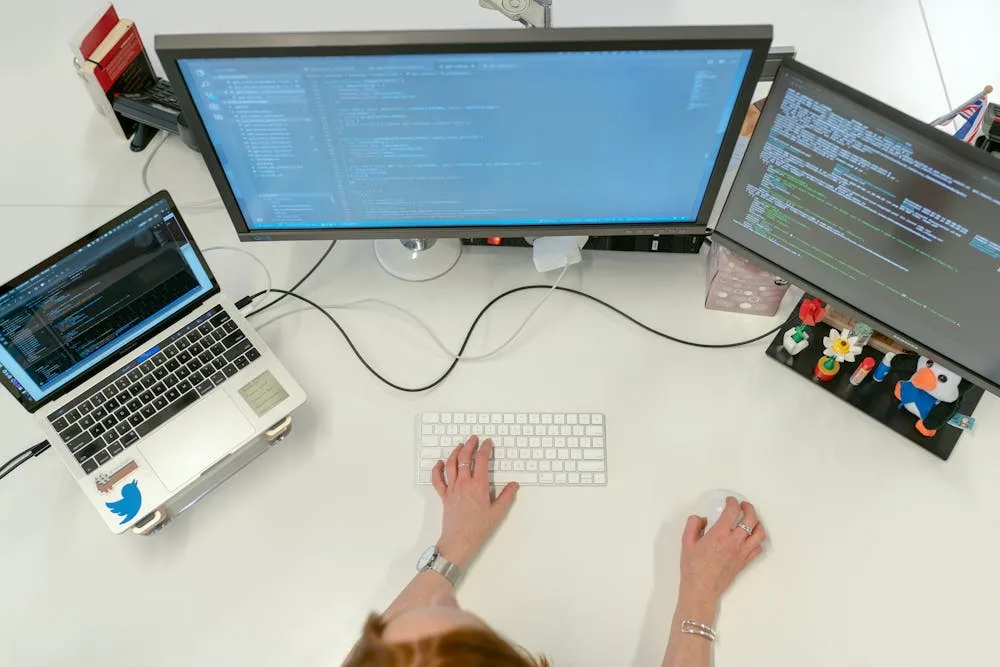
The loop runs continuously. On a crypto market that trades 24 hours a day, this is a real advantage, because the system never needs to sleep. The gap between a signal and an order can be milliseconds, far faster than any person can react.
The connection in step 4 is the critical piece. Your strategy code has to talk to the market somehow, and that link is almost always an API. Without programmatic access, your bot is just a spreadsheet with no way to act.
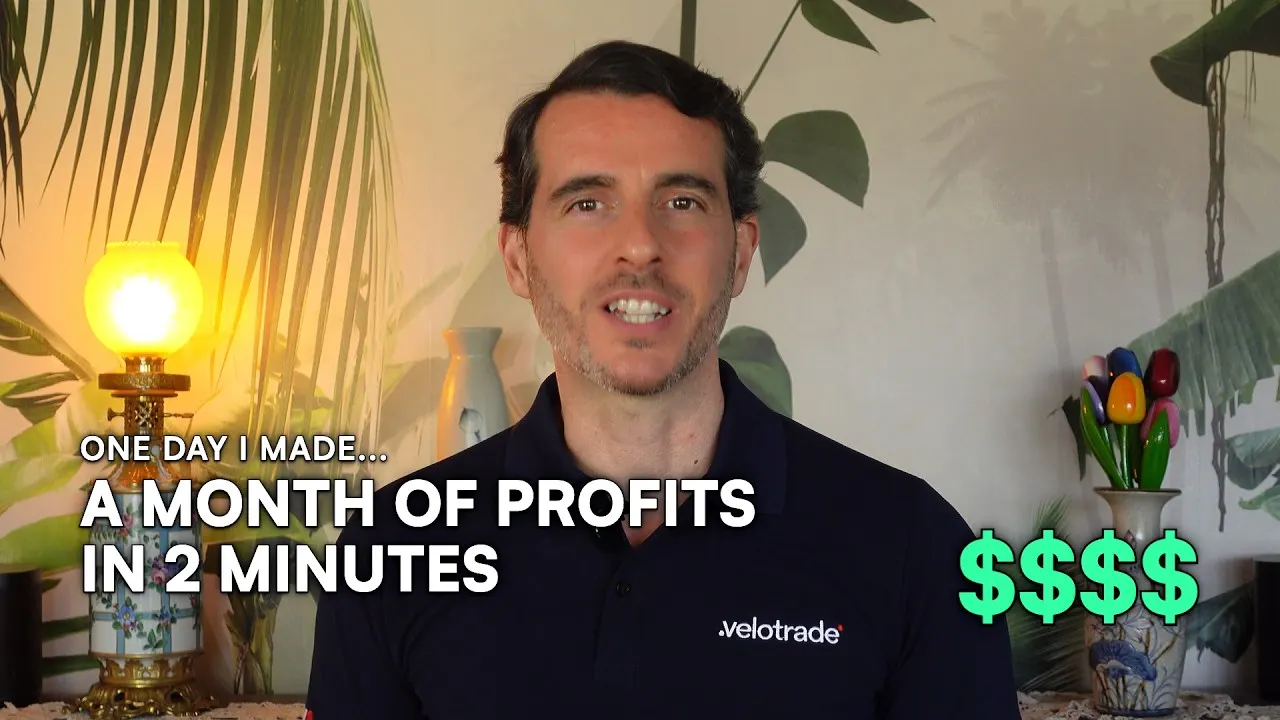
Automation does not remove risk, it moves it into the code. Velotrade CEO Gianluca Pizzituti built arbitrage algorithms on Nikkei futures in Singapore, and one broken update left the system trading a stale price during a session break. The trade made a month's profit by luck, which is exactly why he calls it one of the worst trades of his career. (Arbitrage, latency arbitrage, high-frequency and grid strategies are prohibited on Velotrade accounts; see the rules.)
 4:48
4:48Read the transcript
I once made a month of profit in about two minutes, and it was one of the worst trades of my career.
Further to my last video about the most dangerous winning trade, let me tell you a real story. I am Gianluca Pizzituti, CEO of Velotrade. I've been trading for 25 years, both institutionally and privately.
This story happened when I was trading in Singapore. At the time I was building algorithmic trading strategies, and back then you built almost everything yourself: the logic, the execution, the risk controls, the protection against bad code, hardware failures and software glitches.
Today, many brokers have limits and automatic risk controls. Back then there was much less standing between a coding mistake and a very expensive disaster.
My strategy was a correlation arbitrage between the Nikkei futures trading in Osaka, traded in yen, and the corresponding contracts in Singapore and Chicago, traded in US dollars. The idea was straightforward. If the spread moved far enough, the algorithm would trade one contract and hedge it with one of the others.
My story happened during the normal daily break between the T and T+1 sessions. A couple of days earlier I had made changes to the algorithm, and I must have broken the logic that handled the session gap.
When Osaka entered the break, the system continued treating the last displayed price as credible. That small coding change created a dangerous mismatch between the displayed quote and the actual trading session.
Then there was a sharp move in the S&P 500 futures. That move flowed into the Nikkei contract that was still trading in Singapore. The Singapore price moved. The stale Osaka price did not. To my algorithm, the spread suddenly looked enormous.
I was looking at something else when I heard the sound every electronic trader knows. Boom, boom, boom, boom, boom. It did not stop.
The algorithm kept filling one side and trying to hedge on the Osaka side. But Osaka was closed, so the hedge orders could not execute. Within seconds I had traded hundreds of Nikkei futures on one side and no hedge on the other.
I do not even remember whether I was long or short. I only remember looking at the position and thinking: what on earth has happened?
And then I got lucky. Extremely lucky. The market was thin, the move reversed, and the unhedged orders started filling. I managed to unwind the position at average prices better than the ones my algorithm had originally targeted.
In about two minutes I had made what was probably the profit of the entire month. On paper it looked fantastic. In reality it was a disaster that happened to pay me.
I sat there for several minutes trying to understand what had happened. The code was not protected properly. The market status was not handled correctly. I was distracted. I may have been tired. Several things had failed at the same time.
That position could have moved against me and caused an enormous loss. Instead the market reversed and paid me. But I did not confuse the result with skill. There was no skill in that outcome. It was pure luck.
And that is the point. A profitable trade can still expose a terrible process. If you celebrate the money and ignore the failure, the market may not be so generous next time.
The right response was not to celebrate the profit. It was to recognize that the system had failed, and that pure luck had saved me from a potentially enormous loss. So I stopped, traced the failure and fixed the process. Because a lucky outcome does not make a dangerous mistake acceptable.
If you have ever made money on a trade that you later realized was pure luck, tell me what happened in the comments. See you in the next video.
Algo trading explained through its core building blocks
To keep algo trading explained in plain terms, think of any system as 4 parts working together.
The strategy is the idea. It answers one question: under what exact conditions do I enter and exit? Vague ideas cannot be coded. "Buy when it looks strong" is not a rule. "Buy when price closes above the 20 day high" is.
The data feed supplies the raw prices the strategy reads. Clean, reliable data matters more than beginners expect. A feed that lags or drops ticks will produce phantom signals and bad fills.
The risk module protects the account. It caps how much any single trade can lose and how large a position can get. This is where many bots fail, because a strategy with no risk limits can wipe an account in one bad session.
The execution layer is the API bridge that sends orders and reads fills. It is the hands of the system.
Velotrade gives every account full REST and WebSocket API access at no extra fee and with no approval step. REST is used for placing orders and pulling account data. WebSocket streams live prices in real time so your bot reacts the instant a level is hit. Together they cover both halves of the execution layer.
Types of algorithmic trading strategies
The types of algorithmic trading fall into a handful of families. Most live bots are a variation on one of these. For worked rules and the weaknesses of each family, see our guide to algorithmic trading strategies.
| Strategy type | Core idea | Best market condition |
|---|---|---|
| Trend following | Buy strength, sell weakness, ride the move | Strong directional trends |
| Mean reversion | Fade extremes, bet price returns to average | Range bound, choppy markets |
| Arbitrage | Exploit price gaps between venues or pairs | Any, when gaps appear |
| Market making | Quote both sides, earn the spread | High liquidity, tight ranges |
| Execution algorithms | Split a large order to reduce impact | Any, for large size |
Trend following is the most common starting point because the logic is simple and the rules are easy to test. Mean reversion works well in sideways markets but gets hurt by strong breakouts. A common mean reversion rule fades closes outside the Bollinger Bands, which stretch and contract with volatility. Arbitrage and market making demand low latency and heavy infrastructure, which puts them out of reach for most retail traders. A slower cousin, statistical arbitrage, trades the spread between related assets and takes real market risk. Our explainer on high-frequency trading shows how that speed race works, and why prop firms ban it.
Beginners usually do best with a single, clear trend or mean reversion rule on one instrument. Complexity is not an edge. A simple system you understand and trust beats a complicated one you cannot debug.
Why the venue decides whether your bot can run
You can build the best strategy in the world and still be blocked from running it. Most retail brokers and prop firms restrict or ban automated trading, and the fine print is where good bots go to die. Common restrictions include outright bans on EAs, hidden per trade risk caps, maximum lot size limits, and consistency rules that punish a bot for having one strong day. Before you pick a firm, compare how the prop firms that allow EAs and trading bots word these limits.
This is the point most guides skip. Rules like trailing drawdown or consistency requirements can force a profitable bot to break the account terms even while it makes money. If you plan to automate, read the crypto prop firm rules explained before you write a single line of code, and check the 15-firm review of how prop firm rules apply to automated trading, which sources every claim to the firm's own published rules.
Velotrade is built the opposite way. EAs, bots, and automated trading are allowed on every account with no extra fee and no approval. There is no consistency rule at any stage, so a bot that makes most of its profit in a few strong sessions stays compliant. There is no per trade risk cap and no maximum lot size, so your risk logic runs as you designed it.
The drawdown model matters just as much. Velotrade uses a static maximum drawdown, meaning the loss floor is fixed from your starting balance and never trails your equity up. A bot can bank profit without the failure line creeping closer behind it, which is exactly the behavior an automated system needs to survive a long run of trades.
From tested strategy to funded account
The path from idea to a live, funded bot follows a clear order.
First, write your rules down in plain language. Then code them and backtest against historical data to see how they would have performed. Next, run the bot forward on a demo or simulated feed to confirm it behaves the same on data it has never seen. Only then should you put it on an account that matters.
Velotrade fits the final stage. You take a DXtrade account, connect your bot through the API, and trade a 1-Step or 2-Step challenge across crypto, forex, stocks, indices, and commodities. For the mechanics of connecting a bot to a funded account, see how to run a trading bot on a funded crypto account and the deeper walkthrough on algo bot trading at a crypto prop firm.
If you are still comparing where to deploy, the guide to the best crypto prop firms for algo traders breaks down which firms genuinely allow automation and which only claim to. For the wider context of the model itself, read what crypto prop trading is. To go from concept to a working system, see how to build a trading bot and the DXtrade API setup guide.
The strategy is yours to build. The account is where it gets to run without artificial limits getting in the way.
Velotrade provides education and simulated trading only. It is not a broker, bank, or regulated financial institution, and nothing here is investment advice. All trading involves risk, and past performance of any strategy does not predict future results. Always test your own rules and trade within limits you can afford.
Frequently Asked Questions
About the author

Vittorio De Angelis
Executive Chairman
Former equity-derivatives trader at JP Morgan, Dresdner Kleinwort and Bank of America in London. Later Head of Brokerage at a global broker in Hong Kong.
Velotrade was founded in Hong Kong in 2016 by a team from JP Morgan, Dresdner Kleinwort and Bank of America, has paid out over $2.5 billion to its trade-finance clients, and has been featured in Bloomberg, the Financial Times, the Wall Street Journal and on Nasdaq. Its prop trading evaluations are simulated and educational.
View author page