New to funded trading?
ExplorePerpetual futures (also called perpetual swaps or "perps") are crypto derivatives that let you trade an asset's price, long or short, with leverage and without an expiry date. A perpetual stays open as long as you keep enough margin, and a recurring payment called the funding rate keeps its price close to the spot market. Perps are the most traded product in crypto and one branch of the wider family covered in our guide to crypto derivatives.
Quick answer: A perpetual future is a crypto derivative contract that tracks the price of an underlying asset such as Bitcoin, has no expiry date, and can be traded long or short with leverage. Perpetual futures stay close to the spot price through periodic funding payments exchanged between long and short traders, commonly every 8 hours.
Highlights of this article
- A perpetual future is a futures contract with no expiry, so a position can stay open while margin lasts
- BitMEX launched the perpetual swap in 2016, and perps have since become the dominant crypto derivative
- Funding payments between longs and shorts pull the perpetual price toward the spot index
- Exchanges value positions and trigger liquidations with a mark price built from an index of spot prices
- The main risks are liquidation, funding drag on long holds, and sudden price wicks
Funded accounts
Ready to get funded?
Trade up to $200,000 in firm capital with static drawdown, no consistency rule, and payouts within 24 hours. Pass the challenge and keep up to 90% of your profits.
Get funded from $40Key facts about perpetual futures
| Item | Detail |
|---|---|
| Definition | A futures contract with no expiry that tracks a spot asset and can be traded long or short with leverage |
| Also called | Perpetual swap, perp, perpetual contract |
| First launched | BitMEX, 2016 |
| Price anchor | Funding payments, commonly every 8 hours (intervals and caps vary by exchange) |
| Funding formula | Funding payment = position notional x funding rate |
| Worked example | 10,000 USD notional at 5x needs 2,000 USD margin; a 2% move is a 200 USD gain or loss |
| Main risk | Liquidation when losses eat through your margin |
| Related terms | Funding rate, mark price, index price, open interest, liquidation |
What is a perpetual future?
A perpetual future is a derivative contract whose value follows an underlying asset, such as BTC or ETH, but which never expires. You do not own the coin. You hold a contract that gains when the price moves your way and loses when it moves against you.
Two features set perps apart from buying coins on a spot exchange:
- You can go short as easily as long. Selling a perpetual profits if the price falls, with no need to borrow the coin (see short selling for how shorting works in general).
- You trade with leverage. You post margin, a fraction of the position's notional value, and control the full position size.
Where did perpetual futures come from?
Perpetual futures entered crypto when BitMEX launched its perpetual swap on Bitcoin in 2016. Traditional futures, like those listed on regulated venues such as CME, have fixed expiry dates, so traders must close or "roll" positions into the next contract month. The perpetual swap removed the expiry and replaced settlement with funding payments. Today almost every large crypto derivatives exchange lists perpetuals.
Why do perpetual futures have no expiry?
Perpetual futures have no expiry because a funding mechanism does the job that settlement does for dated futures. A dated future is forced back to spot on expiry day, because at settlement it must be worth exactly the underlying. A perpetual has no such day, so it needs another anchor to stop it drifting from spot when one side gets crowded.
The funding rate is that anchor. When the perpetual trades above the spot index, longs pay shorts. When it trades below, shorts pay longs. Those payments make the crowded side more expensive to hold until the gap narrows.
The chart shows this over an illustrative 48 hours. As buyers push the market up, the perpetual climbs faster than the spot index and opens a premium that peaks at close to one dollar around hour 16. Funding then charges the long side, the premium shrinks, and from around hour 30 the perpetual trades only a few cents above spot while the price dips and recovers.
Who pays the funding rate on perps?
The side the market is crowded on usually pays the funding rate. It is a periodic payment between long and short holders, charged at fixed times (commonly every 8 hours), and only traders holding a position at the funding timestamp pay or receive it.
Funding payment = position notional x funding rate
- If the rate is positive, longs pay shorts.
- If the rate is negative, shorts pay longs.
Most exchanges build the rate from an interest component and a premium component that measures how far the perpetual trades from the index. The exact formula, interval and cap vary by exchange. Our guide to the funding rate explains how to read funding data.
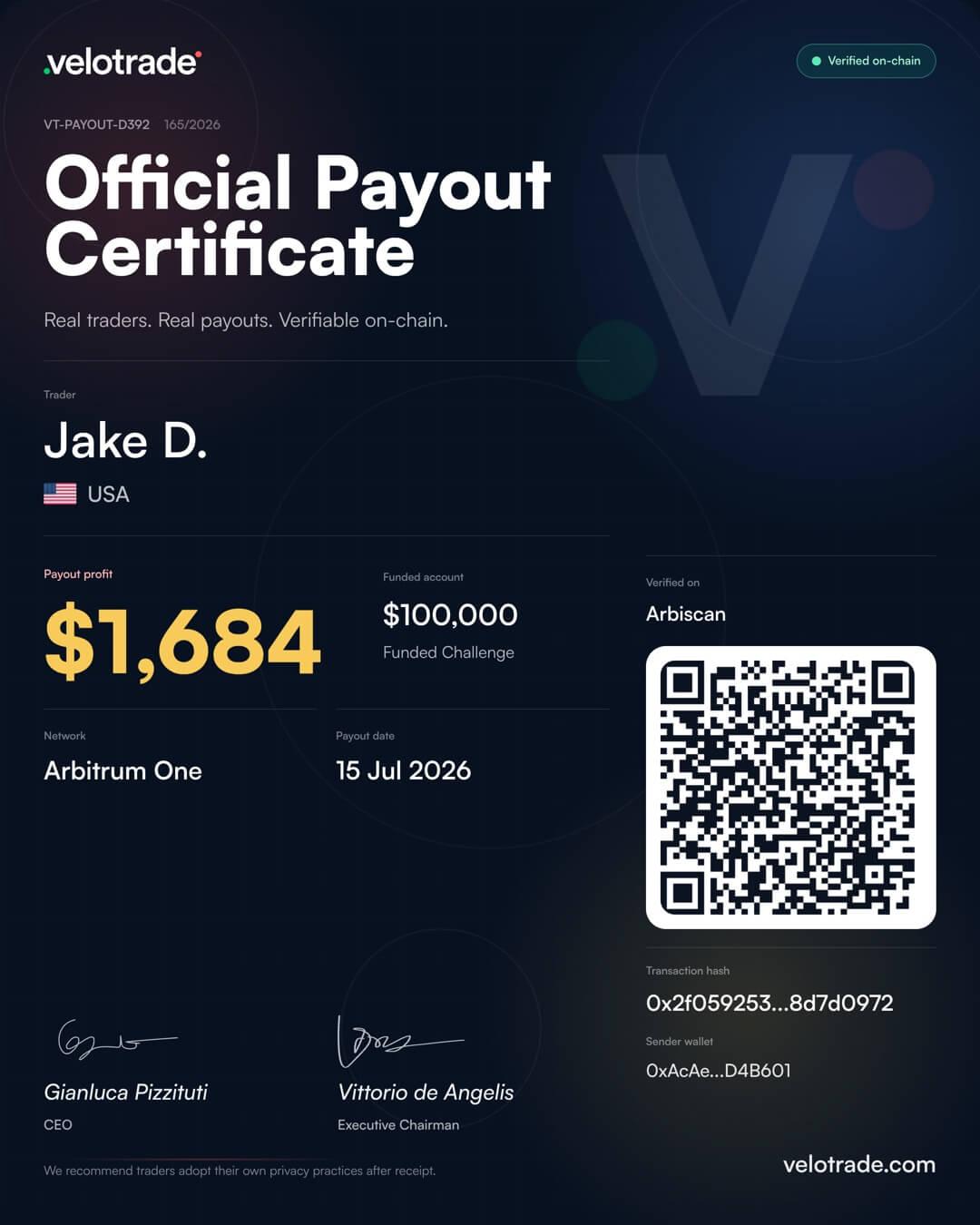
Payout proof
Fast, real payouts. Traceable on Arbitrum.
- Paid within 24 hours of approval
- Settled on Arbitrum in USDC or USDT
- Look up any transaction on Arbiscan

What are index price and mark price?
The index price is a reference price for the underlying asset, usually an average of spot prices from several major exchanges, so one thin order book cannot easily distort it.
The mark price is the price an exchange uses to value open positions, calculate unrealised profit and loss, and decide when to liquidate. It is typically based on the index price plus a smoothed basis or premium component, so it follows the market but ignores brief spikes in the last traded price. Methods differ by exchange. On most venues a short wick in the last price may not liquidate you if the mark price holds, but a sustained move will.
How do leverage and margin work on perps?
Leverage on a perpetual is the ratio between the position's notional value and the margin you post. At 5x, every 1,000 USD of margin controls 5,000 USD of position.
- Initial margin is what you post to open the position (notional divided by leverage).
- Maintenance margin is the minimum equity needed to keep it open. Below that, the exchange liquidates the position.
Because maintenance margin sits above zero, liquidation normally happens before the whole initial margin is gone. Our guide to liquidation covers the mechanics, and prop firm leverage explains how leverage is set in simulated evaluations.
The chart compares 1,000 USD in spot with the same 1,000 USD used as margin for a 5x futures position. In spot, each 1% move changes the position by 10 USD. At 5x, each 1% move changes it by 50 USD, so a 20% fall takes the full 1,000 USD of margin. A spot holder can wait out a drawdown; a leveraged trader can be forced out before any recovery. For the full comparison, see crypto futures vs spot.
Worked example: a 5x BTC perpetual trade
Trading fees are left out here because they vary by exchange and account tier.
The setup
- Long BTC perpetual, notional value 10,000 USD, leverage 5x.
- Initial margin = 10,000 / 5 = 2,000 USD.
If the price rises 2%
- Profit = 10,000 x 2% = 200 USD, a return of 200 / 2,000 = 10% on margin.
If the price falls 2%
- Loss = 10,000 x 2% = 200 USD, leaving 2,000 minus 200 = 1,800 USD of margin.
Funding over three days at +0.01% per 8 hours (long pays)
- Payments = 3 per day x 3 days = 9.
- Cost per payment = 10,000 x 0.01% = 1 USD.
- Total funding = 9 x 1 = 9 USD.
Nine dollars is small next to a 200 USD price move, but funding changes: at triple the rate the same hold costs 27 USD, and if funding turns negative the long receives payments instead.
Where liquidation sits
A 20% fall would erase the full 2,000 USD (10,000 x 20% = 2,000). Because the exchange liquidates once equity drops below maintenance margin, liquidation comes somewhat before a 20% fall.
Perpetual futures vs dated futures
Both give leveraged long or short exposure, but they anchor to spot in different ways.
| Feature | Perpetual futures | Dated futures |
|---|---|---|
| Expiry | None | Fixed date (monthly or quarterly, for example) |
| How price meets spot | Funding payments, commonly every 8 hours | Converges to spot at settlement |
| Holding cost | Funding, positive or negative | Built into the price as a premium or discount to spot (basis) |
| Rollover | Not needed | Close or roll before expiry |
| Typical venues | Crypto derivatives exchanges | Crypto exchanges and regulated venues such as CME |
What are the main risks of perpetual futures?
The main risks are liquidation, funding drag and sudden price wicks, all magnified by leverage. Broker disclosures and academic studies consistently find that most retail traders who use leverage lose money, and crypto volatility sharpens that risk.
- Liquidation. Higher leverage puts the liquidation price closer to entry. At 20x, roughly a 5% adverse move can be enough, and crypto can move 5% in minutes.
- Funding drag. Holding the crowded side means paying funding every interval, which eats into profit even when the direction is right.
- Wicks. Thin liquidity, cascading liquidations and news can produce sharp wicks. Mark price filters some single-venue spikes, but a broad, fast move still triggers stops and liquidations, and stops can fill worse than their trigger price.
How do you trade perpetual futures responsibly?
You trade perps responsibly by sizing every position so that one bad trade cannot end your account.
- Decide your risk first. Choose a fixed share of your account to risk per trade, for example 0.5% to 1%.
- Place the stop before the entry. Put the stop-loss where your trade idea is proven wrong.
- Size from the stop distance. Position size = amount at risk / stop distance. Risking 100 USD with a 2% stop gives a 5,000 USD notional.
- Keep leverage well below the maximum. Check that your liquidation price sits far beyond your stop.
- Check funding before holding. Note the current rate and how many intervals you will hold through.
- Prefer limit orders. Gianluca Pizzituti, Velotrade's co-founder, favours limit orders to control the entry price.
- Journal and review. Record entries, exits, funding paid and your reasoning, then review weekly.
These steps belong inside a wider risk management plan. Avoid overtrading: not trading is a valid decision, and a profitable trade is not automatically a good one.

Can AI help with trading perpetual futures?
AI can help with parts of the work, such as screening markets for unusual funding or volatility, summarising a trading journal, or testing rule-based ideas on historical data. See AI trading strategies and backtesting trading strategies.
AI does not remove the risks of leverage. No model can reliably predict a sudden wick or funding spike, and an automated system can lose money fast at high leverage. Human judgement on size and risk limits remains essential.
How do perps compare with trading in a prop evaluation?
Velotrade, a multi-asset prop trading firm, offers simulated evaluations with more than 100 crypto instruments that trade 24/7. Velotrade does not charge a variable funding rate. A flat overnight rate of 0.05% of notional applies to crypto positions open at 00:30 UTC, every day including weekends, the same whether long or short, and crypto commission is 0.03% per side. For price comparison, Velotrade's FAQ points traders to the matching KuCoin USDT perpetual symbols on TradingView.
Applied to the example above, a 10,000 USD BTC position held through three 00:30 UTC cutoffs would cost 3 x 5 = 15 USD in overnight fees, plus 3 USD commission per side. BTC leverage is 10x in the challenge and 5x once funded (see the instruments page for every instrument). The hard limits are a daily loss limit, reset at 00:30 UTC from the higher of balance or equity (5% on CLASSIC 2-Step, 4% on CLASSIC 1-Step, 3% on PRO 1-Step), and a static maximum drawdown. Compare plans on the challenges page. This is an educational, simulated environment, not investment advice.
Frequently Asked Questions
About the author

Gianluca Pizzituti
Chief Executive Officer
Formerly on the derivatives desk at Dresdner Kleinwort in London, then founded and ran a proprietary HFT firm in FX and equity indices out of Singapore.
View author page