Size every trade from your risk and stop
ExploreLeverage is one of the first things traders check before taking a prop firm challenge, and one of the most misunderstood. The headline number a firm advertises is rarely the leverage you can actually deploy, because most firms quietly cap how much risk you can put on a single trade. This guide explains what leverage means on a funded account, why usable leverage matters more than the headline figure, and exactly how much Velotrade gives you per instrument.
Quick answer: Velotrade gives up to 10x leverage on BTC during the challenge and 5x once funded, with no maximum risk per trade and no lot-size cap. That combination matters more than a bigger headline multiple, because leverage you cannot fully deploy is not leverage you can use. You size every position against a fixed drawdown, not an arbitrary per-trade limit.
Highlights of this article
- Leverage on a funded account lets you control a larger position than your account balance would allow on its own
- The headline leverage figure is often neutered by a hidden cap on risk or lot size per trade
- Usable leverage, the amount you can genuinely put to work, is the number that actually matters
- Velotrade offers up to 10x on BTC during the challenge and 5x once funded, with no maximum risk per trade and no lot-size cap
- Higher usable leverage raises both upside and liquidation risk, so it has to be sized against your drawdown
What Leverage Means on a Funded Account
On a funded account, leverage is the multiple of your account balance that you can control in open positions. At 5x leverage, a $10,000 funded account can hold up to $50,000 of exposure. You are not borrowing money in the retail sense: the firm provides the capital and the risk framework, and leverage defines how large a position that capital can support.
This is different from leverage on your own brokerage account, where you post margin and borrow against it. For a full breakdown of that distinction, see funded trading vs leverage trading. The practical effect is the same, though: more leverage means a given price move produces a larger profit or loss on your account.
The Number That Matters Is Usable Leverage, Not Headline Leverage
Here is the part most comparison tables miss. A firm can advertise high leverage and then cap the risk you are allowed to take on any single trade, or cap your maximum lot size. A crypto firm like HyroTrader, for instance, caps the realised loss on any single position at 3% of the initial balance. When that happens, the headline leverage is a marketing figure you can never fully use. For how its rules stack up against a crypto-native firm, see FundingPips vs Velotrade.
Say a firm advertises 1:100 but limits you to a maximum of 1% risk per trade or a fixed lot cap. The moment you try to build a position that uses the leverage, the risk rule stops you. Your effective, usable leverage is a fraction of the headline. The number that decides how you can actually trade is not the multiplier on the sales page, it is the multiplier you are allowed to deploy once the rules are applied.
This is why two firms with identical headline leverage can trade completely differently. The one without a per-trade risk cap lets you concentrate your leverage where your edge is strongest. The one with a cap forces you to spread thin regardless of conviction.
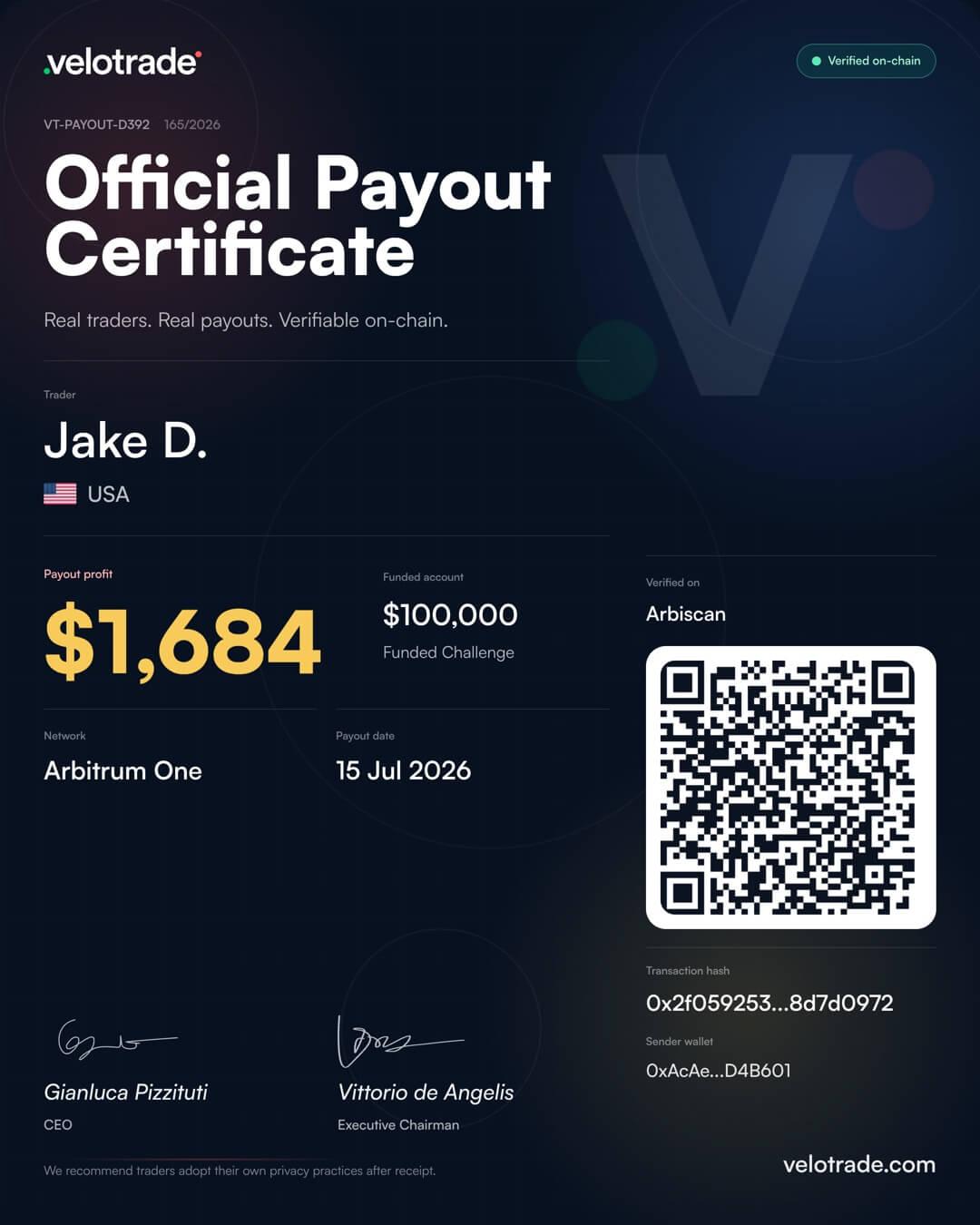
Payout proof
Fast, real payouts. Traceable on Arbitrum.
- Paid within 24 hours of approval
- Settled on Arbitrum in USDC or USDT
- Look up any transaction on Arbiscan

Velotrade Leverage by Instrument
Velotrade sets leverage by asset tier, with slightly higher leverage during the challenge and a conservative step down once you are funded and trading real capital.
| Instrument tier | Examples | Challenge leverage | Funded leverage |
|---|---|---|---|
| Bitcoin | BTC | 10x | 5x |
| Large-cap crypto | ETH, SOL | 6x | 5x |
| Mid-cap crypto | XRP, BNB, DOGE, ADA, and similar | 3x | 2x |
| Other crypto | Smaller-cap tokens | 2x | 2x |
| Index ETFs | SPY, QQQ, IWM | 6x | 5x |
| Commodities | Gold, silver, oil, natural gas | 6x | 5x |
| Single stocks | AAPL, TSLA, NVDA, and 74 more | 5x | 3x |
These are spot-style multiples rather than the triple-digit figures some crypto venues advertise, and that is deliberate. The point is not the biggest possible number, it is leverage you can fully use without a per-trade cap working against you. Because exposure is calculated on notional value, it helps to understand how notional value works before sizing a position.
Why Velotrade Does Not Cap Your Risk Per Trade
Velotrade has no maximum risk per trade and no lot-size cap. You decide how to allocate the leverage across your positions, including putting the full amount behind a single high-conviction trade if that is your strategy.
| Common prop firm limit | What it restricts | Velotrade |
|---|---|---|
| Maximum risk per trade | How much you can lose on a single position | None |
| Maximum lot or position size | How large any one trade can be | None |
| Maximum drawdown | Total loss on the account | Static, the only sizing limit |
This matters because a per-trade risk cap is the most common way a firm quietly limits you. Removing it means the 5x on a funded large-cap position is genuinely 5x, not 5x on paper and 2x in practice. Combined with the rest of the rule set, a static drawdown on every plan, no consistency rule, news trading allowed, and weekend holding permitted, it gives you the room to trade your actual strategy. For the complete framework, see the crypto prop firm rules explained or the full trading rules.
The only guardrail that governs your sizing is the drawdown, which is the honest place for a limit to sit: it caps total loss, not the shape of any individual trade.
"Most firms hand you leverage and then quietly cap your risk per trade, so you can never fully use it. We do the opposite: no maximum risk per trade, no lot-size cap, and one honest limit, the drawdown. That is what usable leverage actually means.", Velotrade trading team
Free calculator
Is prop trading worth it for you?
Enter your account size, expected monthly profit, and how many attempts to pass. See your break-even month and 12-month net in seconds.
Use the free ROI calculatorLeverage and Liquidation: Managing the Downside
Higher usable leverage cuts both ways. The same 5x that doubles your gain on a favorable move doubles the loss on an adverse one, and a leveraged position can be liquidated if price moves far enough against it. On an exchange account that usually starts with a margin call, and cross vs isolated margin decides whether one bad trade can drain the whole balance. Understanding what liquidation means in trading is essential before you size up, and a crypto liquidation calculator shows how much closer each step up in leverage brings it.
On a funded account the practical risk is not just liquidation of a single position, it is breaching your account drawdown. Because Velotrade uses a static maximum drawdown, the loss limit is fixed from your starting balance and never trails your equity upward, so you always know exactly how much room a leveraged trade has before it threatens the account.
How to Use Leverage Without Blowing the Drawdown
The traders who use leverage well treat it as a tool for expressing conviction, not a way to trade bigger for its own sake. A few principles:
- Size each position from your drawdown, not from the maximum leverage available. The leverage sets the ceiling; your risk tolerance sets the actual size. A position size calculator turns that risk into an exact number of units, and on currency pairs the lot size calculator gives the answer in lots. Leverage does not change what a pip is worth at a given lot size; the pip value calculator shows that figure for any pair.
- Concentrate leverage where your edge is clearest rather than spreading it thin across weak setups.
- Account for volatility. A 5x position in a large-cap moves very differently from a 2x position in a thin altcoin.
- Keep a buffer below your drawdown so a normal adverse swing does not end the account.
Used this way, the absence of a per-trade cap is an advantage rather than a trap: it lets a disciplined trader deploy full size on the trades that deserve it. To see how leverage terms compare across the market, see the best crypto prop firms in 2026, and when you are ready to put it to work, explore Velotrade's challenges. If you would rather not pay an entry fee, you can also win a funded account for free.
Frequently Asked Questions
About the author

Vittorio De Angelis
Executive Chairman
Former equity-derivatives trader at JP Morgan, Dresdner Kleinwort and Bank of America in London. Later Head of Brokerage at a global broker in Hong Kong.
Velotrade was founded in Hong Kong in 2016 by a team from JP Morgan, Dresdner Kleinwort and Bank of America, has paid out over $2.5 billion to its trade-finance clients, and has been featured in Bloomberg, the Financial Times, the Wall Street Journal and on Nasdaq. Its prop trading evaluations are simulated and educational.
View author page