Trade gold and commodities with funded capital
ExploreSilver is a two-sided market: it is a precious metal that trades as a safe haven like gold, and an industrial metal used in solar panels, electronics, and electric vehicles. That dual demand makes it more volatile than gold and a favourite for traders who want bigger intraday ranges. There is more than one way to trade it, and the right route depends on your account size and where you live.
This guide explains what silver trading is, the practical ways to trade it, what actually moves the silver price, and how traders access silver through a funded account.
Highlights of this article
- Silver (XAGUSD) is both a precious metal and an industrial metal, which makes it more volatile than gold
- You can trade silver as a spot CFD (XAGUSD), as futures, or on a funded account
- Silver moves on the same macro forces as gold, plus industrial demand and the gold-silver ratio
- Silver's higher volatility means position sizing against a fixed loss limit matters more than on gold
- On a Velotrade funded account you trade silver (XAG) at up to 6x, alongside gold, crypto, forex, indices, and other commodities
What is silver trading?
Silver is quoted as XAGUSD, the price of one troy ounce of silver in US dollars. XAG is the ISO code for silver (the "X" prefix marks a precious metal, like XAU for gold), and USD is the quote currency. When XAGUSD reads 30.00, one ounce of silver costs 30 US dollars.
What makes silver distinctive is its split personality. Roughly half of silver demand is industrial: it is used in solar panels, electronics, batteries, and medical devices. The other half is investment and jewellery demand, where silver behaves like a smaller, faster version of gold. That combination means silver reacts both to the macro forces that drive gold and to the industrial cycle, which is why it moves harder in both directions.
Thinking about using this on a funded account? Before you do, read the best prop firms for gold traders, how a static maximum drawdown works and how the top prop firms compare.
The ways to trade silver
1. Spot silver (XAGUSD CFD). A contract for difference that tracks the spot silver price. You go long or short with leverage and never take delivery of metal. This is the most flexible route for position sizing and the most common for active retail traders.
2. Silver futures. Exchange-listed contracts (CME's full-size SI and micro SIL) to buy or sell silver at a set price on a future date. Futures give deep exchange liquidity and transparent pricing, but fixed contract sizes and expiries make fine sizing harder for smaller accounts and add rollover management.
3. A funded account. Trade silver pricing on a firm's capital against a profit split, with your downside limited to a one-time challenge fee.
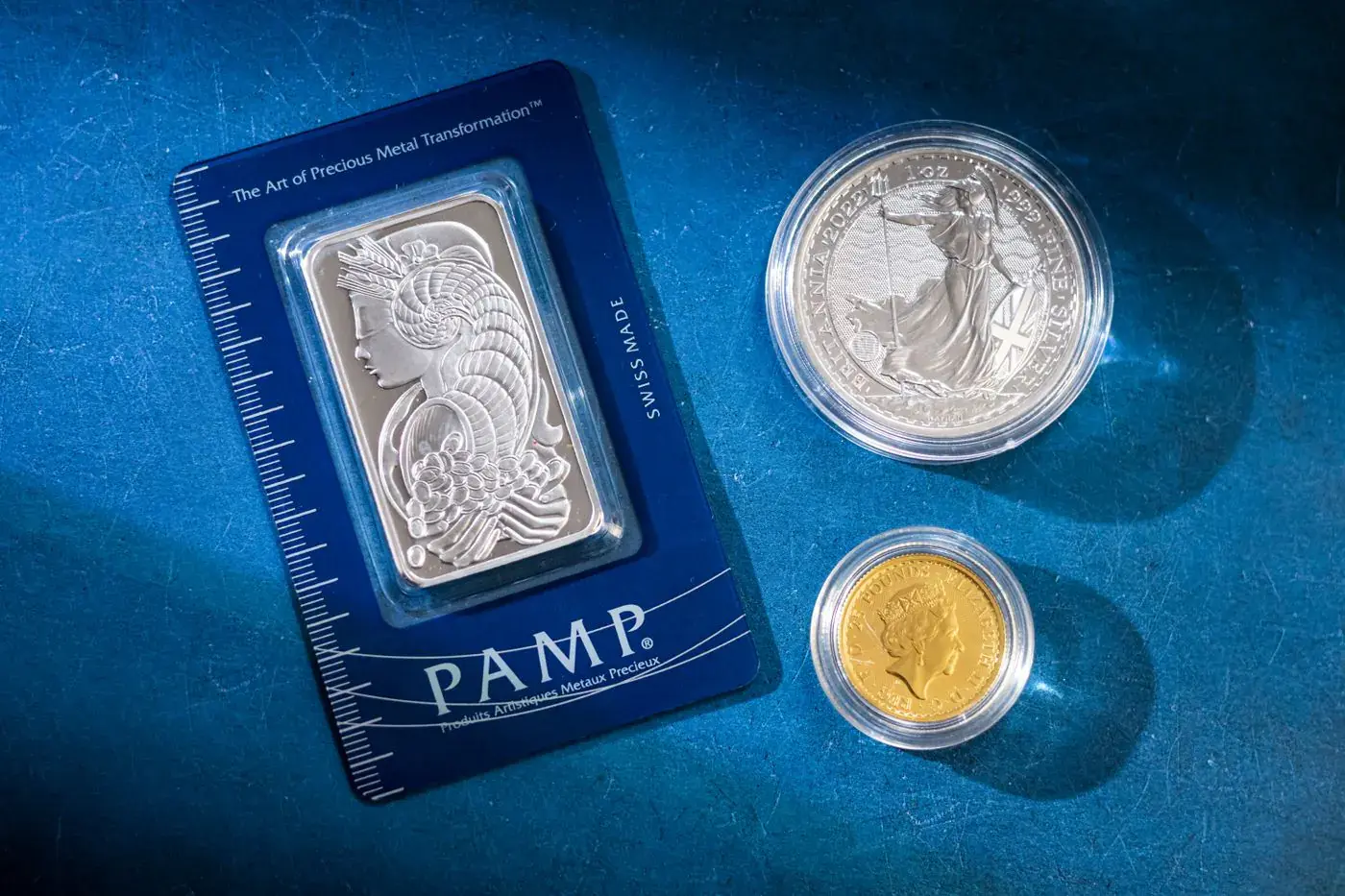
Physical silver (bars and coins) exists too, but that is ownership rather than trading. For how position value is calculated across any of these, see notional value explained.
What moves the silver price
Silver is driven by the same forces as gold, plus an industrial layer:
- Real interest rates. Like gold, silver pays no yield, so when real rates fall, holding it costs less and demand rises. See what is FOMC trading.
- The US dollar. Silver is priced in dollars, so a stronger dollar tends to pressure it and a weaker dollar tends to support it.
- Safe-haven demand. In risk-off periods, silver catches some of the same flows as gold, though it is the more volatile of the two.
- Industrial demand. Because half of silver demand is industrial, global growth, manufacturing activity, and the solar and EV cycles move the price in a way that does not affect gold.
- The gold-silver ratio. Traders watch how many ounces of silver equal one ounce of gold. When the ratio is historically high, some traders favour silver expecting it to catch up, and vice versa.

Silver vs gold: what is the difference for traders?
Both are precious metals quoted against the dollar, and they often move together, but silver behaves differently in practice:
- Volatility. Silver is typically more volatile than gold, with larger percentage swings, because the market is smaller and half its demand is cyclical.
- Industrial exposure. Gold is almost purely a monetary and safe-haven asset; silver carries a real industrial-demand component.
- Sizing. Because silver moves harder, the same dollar position carries more risk than on gold, so size against your loss limit accordingly.
For the gold side of the comparison, see how to trade gold and what is XAUUSD.
Trading silver on a funded account
A funded account lets you trade a firm's capital against a profit split, with your downside limited to the challenge fee. For a full comparison of the model against trading your own money, see funded trading vs leverage trading.
Velotrade offers silver as a first-class instrument on its commodities funded account, next to gold and oil:
- Silver (XAG) trades at up to 6x leverage on the challenge (5x funded), with commission of 0.01% per side and no spread markup.
- It sits on one DXtrade funded account alongside gold, crude oil, copper, natural gas, crypto, forex, indices, and stocks, so you can rotate between markets without switching firms. See the full instrument list.
- The rules are calibrated for active trading: static maximum drawdown (the loss floor is fixed from your starting balance and never trails your equity), no consistency rule, and news trading permitted, which matters on silver because it moves hard around macro releases.
Velotrade is unregulated and offers educational, simulated evaluations with real-time market pricing. It is not a broker, dealer, or custodian, and no orders are placed on an exchange.
Silver trading basics
- Volatility. Silver can move several percent in a session, more than gold, so size positions against your daily loss limit, not against your conviction.
- Sessions. Silver is most active during the London and New York overlaps, when liquidity is deepest and spreads tightest.
- Correlation. Silver usually tracks gold but with bigger swings, and it can decouple when industrial demand or the solar and EV cycles dominate the narrative.
- Style. Those bigger swings reward patience, which is why many metals traders use swing trading strategies rather than chasing intraday moves. Silver often coils into wedge patterns before a fast break, and its industrial demand makes supply and demand zones on the daily chart worth marking.
- The ratio trade. Some traders trade the gold-silver ratio itself, going long one metal and short the other rather than taking outright direction. It is a simple form of pairs trading, and both legs count toward your risk.
To compare firms for metals and commodities, see best multi-asset prop firm, and for gold specifically, see best prop firm for gold.
Related reading: Tokenized Gold vs Spot Gold.
Frequently Asked Questions
About the author

Vittorio De Angelis
Executive Chairman
Former equity-derivatives trader at JP Morgan, Dresdner Kleinwort and Bank of America in London. Later Head of Brokerage at a global broker in Hong Kong.
Velotrade was founded in Hong Kong in 2016 by a team from JP Morgan, Dresdner Kleinwort and Bank of America, has paid out over $2.5 billion to its trade-finance clients, and has been featured in Bloomberg, the Financial Times, the Wall Street Journal and on Nasdaq. Its prop trading evaluations are simulated and educational.
View author page