Trade crypto with funded capital
ExploreProfit split is the most advertised number in prop firm marketing. It is also one of the least useful variables for deciding which firm to use.
A 95% split at a firm with a consistency rule, news trading restrictions, and tick-by-tick trailing drawdown produces worse real-world outcomes for most traders than an 85% split at a firm with none of those restrictions. The rules determine whether you reach the split. The split only matters if you get funded.
This guide covers crypto prop firm profit splits, what actually determines your take-home income, and where the headline percentage understates or overstates the real value.
Highlights of this article
- Most top-tier crypto prop firms offer 80-90% profit splits. The differences between them are smaller than the rule differences.
- Velotrade offers up to 90% with no consistency rule, static drawdown on all plans, and an institutional hedging model that mirrors and hedges selected trader positions
- HyroTrader offers up to 90% with real Bybit exchange execution
- BrightFunded offers up to 90% for multi-asset traders
- The rule set determines whether you reach the split. Always evaluate rules before split percentage.
- Institutional hedging at Velotrade means the firm profits when traders profit. This is a structural advantage over firms that depend on trader failure.
Why profit split is the wrong starting variable
Every major prop firm advertises 80-95%. That 15-point range sounds meaningful. It is not, for most traders.
The difference between 80% and 90% on a $100,000 account generating 5% per month is $500 per month ($4,000 vs $4,500). Over a year, $6,000.
The difference between passing and failing an evaluation because of a consistency rule, a news trading restriction, or a tick-by-tick trailing drawdown model that tightened your buffer on an intraday run is the entire funded account income.
Choose the rule set that fits your strategy. Then compare splits within the firms whose rules you can actually trade within.
Payout proof
Fast, real payouts. Traceable on Arbitrum.
- Paid within 24 hours of approval
- Settled on Arbitrum in USDC or USDT
- Look up any transaction on Arbiscan


Crypto prop firm profit split comparison
| Firm | Profit split | Drawdown model | Consistency rule | News trading | Starting split |
|---|---|---|---|---|---|
| Velotrade | Up to 90% | Static | None | Allowed | 80% |
| HyroTrader | Up to 90% | Static max, trailing daily | 40% (evaluation) | Allowed | 80% |
| BrightFunded | Up to 90% | EOD trailing | None | Allowed | 80% |
| DNA Funded | Up to 90% | EOD trailing | None | Allowed | 80% |
| FundedNext | Up to 95% | Fixed/EOD (varies) | Varies by plan | Varies | 60-80% |
| FTMO | Up to 90% | Fixed | Yes | Restricted | 80% |
Notes on the table:
- "Up to" means the maximum achievable, typically requiring a scaling plan or specific account type
- Starting split is what you receive on day 1 of funding before any scaling applies
- FundedNext's 95% is achievable on specific plan types with specific scaling milestones
Firm-by-firm breakdown
Velotrade: up to 90%, institutional hedging model

Split: Up to 90% Starting split: 80% from day 1 Scaling: Split increases with consistent performance
Velotrade's 90% split is competitive with the best available in the market. What differentiates it from other 90% offers is the model behind it.
Velotrade uses an institutional hedging model. With its own capital, it mirrors selected trader positions and hedges them on Tier-1 exchanges, keeps some positions on an internal book, and uses insurance hedging through providers. Consistent trader profits become low-risk revenue for the firm, so its interests point the same way as yours. At a firm that profits mainly when funded traders lose, interests are structurally opposed.
This distinction matters practically. A book-model firm has a financial incentive to design rules that cause breaches. An institutionally hedged firm profits more when you trade successfully and generate a split. The incentive structure is aligned, not opposed.
For the full rule stack, see Velotrade review 2026.
HyroTrader: up to 90%, starting at 80%
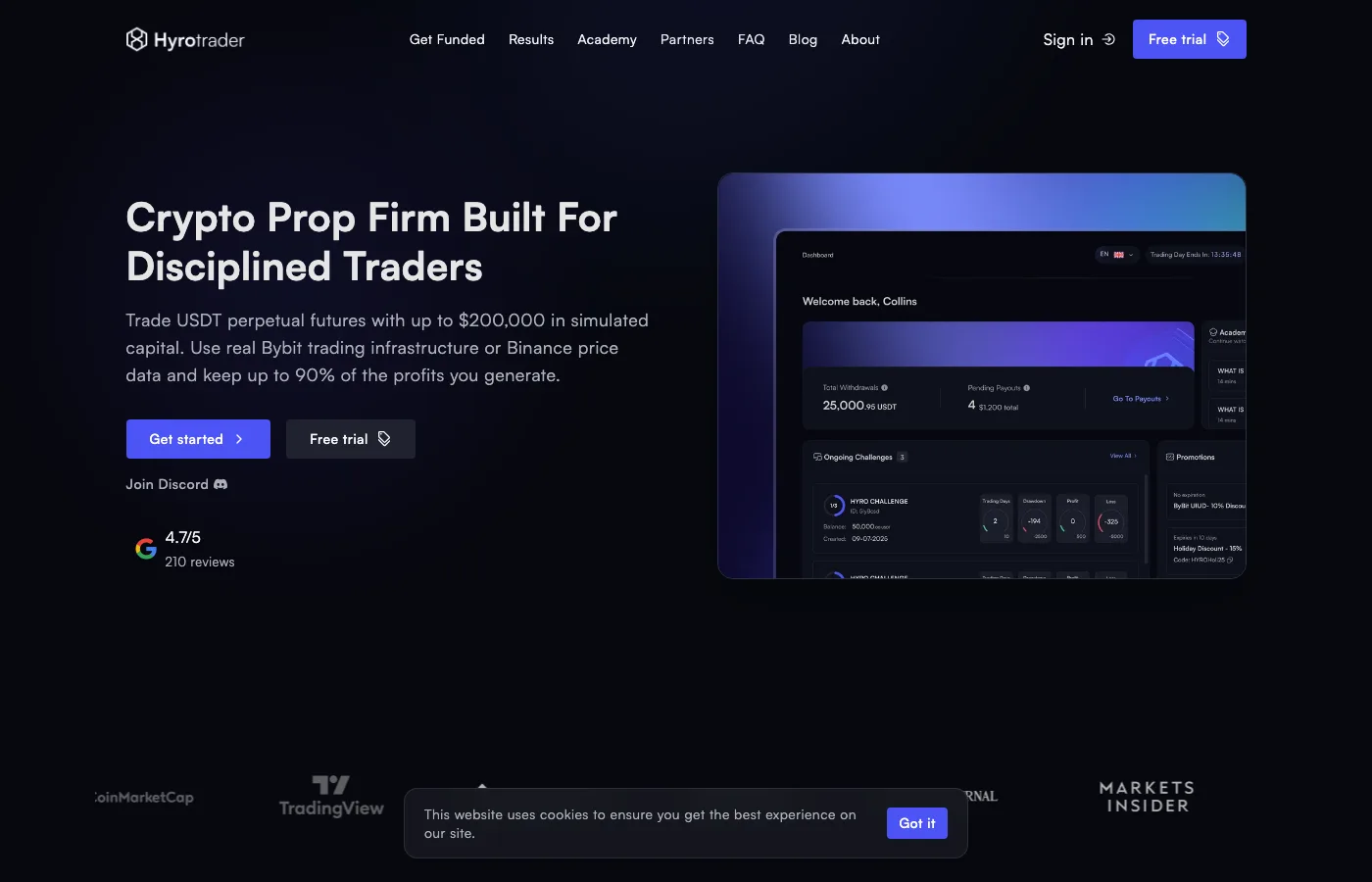
Split: Up to 90% Starting split: 80%, rising 5 points every four months of consistent performance Exchange: Real Bybit connectivity on funded accounts
HyroTrader's differentiator is real exchange execution through Bybit. Funded account trades execute on real Bybit order books, not synthetic pricing. For strategies sensitive to fill quality, the execution difference can affect real-world results independently of the split percentage.
HyroTrader starts at 80% and reaches 90% after about eight months of consistent performance, while Velotrade offers up to 90% from the first payout. Model your expected monthly income against the timeline to the ceiling, not just the maximums.
For a full comparison, see HyroTrader vs Velotrade and HyroTrader review 2026.
BrightFunded: up to 90%, multi-asset

Split: Up to 90% Markets: Forex, indices, crypto Consistency rule: None
BrightFunded offers up to 90% across its multi-asset range. For traders who trade forex and indices alongside crypto, this is the most comparable split structure to Velotrade without the crypto-native specialization.
No consistency rule is a meaningful structural advantage for traders with concentrated sessions. For a full comparison, see BrightFunded vs Velotrade and BrightFunded review 2026.
What actually drives your take-home income
Starting split vs maximum split. Most firms start you at a lower split and increase it through a scaling program. A firm advertising 95% might start you at 60%. A firm advertising 90% might start you at 80%. The starting split applied to your first 3-6 months of funded trading matters more than the eventual ceiling.
Monthly return rate. Split percentage is a multiplier on your trading performance. A 90% split on a 3% monthly return is $2,700 on a $100,000 account. An 85% split on a 5% monthly return is $4,250. Better rules that let you trade your actual strategy will produce higher return rates than a 5-point split premium at a firm whose rules create friction.
Payout reliability. A 95% split that is not paid is worth zero. Verify payout track record independently before any split percentage matters. Look for confirmed payouts across third-party platforms, not firm-published screenshots.
Fee-to-income ratio. The challenge fee is a fixed cost against your funded account income. On a $300 challenge fee, breaking even requires roughly $333 of funded account income at 90% split. At a firm with a 20% pass rate, the true economic cost includes failed attempts. Model total cost across expected attempts, not just one-time fees.

When a higher split is genuinely better
If two firms have identical rule sets and the only difference is the split percentage, choose the higher split.
In practice, this situation almost never exists. Every firm that advertises a higher-than-market split compensates through some combination of tighter rules, higher challenge fees, lower starting splits, or less favorable evaluation mechanics.
The exception: scaling plans that reward consistent funded account performance with automatic split increases. If you are a consistently profitable funded trader, a firm with a well-structured scaling program that reaches 90% within 6 months of consistent performance is genuinely better than a flat 85% firm.
Funded accounts
Ready to get funded?
Trade up to $200,000 in firm capital with static drawdown, no consistency rule, and payouts within 24 hours.
Start your challengeFree calculator
Is prop trading worth it for you?
Enter your account size, expected monthly profit, and how many attempts to pass. See your break-even month and 12-month net in seconds.
Use the free ROI calculatorLast updated: June 2026. Profit split structures and evaluation conditions change regularly. Verify directly with each firm before purchasing.
Frequently Asked Questions
About the author

Vittorio De Angelis
Executive Chairman
Former equity-derivatives trader at JP Morgan, Dresdner Kleinwort and Bank of America in London. Later Head of Brokerage at a global broker in Hong Kong.
View author page