Trade crypto with funded capital
ExploreGetting your first funded crypto account is not just about finding a firm that will sell you a challenge. It is about finding a firm whose rules, drawdown model, and support structure give you a realistic chance of passing and staying funded before you have years of prop trading experience behind you. Most beginners fail not because they cannot trade, but because they choose a firm whose rules are designed for experienced traders.
This guide covers what to look for as a beginner, which firms make the most sense for newer traders, and what to avoid when you are still building your edge. For a broader comparison across all trader profiles, see best crypto prop firms in 2026. If you trade more than crypto, our market-neutral guide on how to become a funded trader covers the full path, and how to read stock charts covers the chart basics every evaluation assumes.
Highlights of this article
- Static drawdown is the most forgiving model for beginners - the floor never moves against you. EOD trailing is the next best option: the floor only moves at day close, never intraday.
- The consistency rule is a hidden trap for beginners. One strong day can void your evaluation unless the firm explicitly removes it.
- Starting with a smaller account ($5,000-$10,000) at lower fees lets you learn the rules without expensive restarts.
- Crypto-only firms have more relevant support, tighter market focus, and rules calibrated to crypto volatility.
- The best beginner firm is not always the cheapest. It is the one whose rules match how you actually trade.
Payout proof
Fast, real payouts. Traceable on Arbitrum.
- Paid within 24 hours of approval
- Settled on Arbitrum in USDC or USDT
- Look up any transaction on Arbiscan


What makes a crypto prop firm beginner-friendly?
Not all prop firms are built the same. Some are designed for experienced traders who know exactly how to manage intraday risk in volatile conditions. Others have structures that are far more forgiving for traders who are still developing consistency. Here is what to look for.
1. Static or EOD trailing drawdown, not tick-by-tick
Drawdown model is the most important rule to understand before choosing a firm. The difference between EOD trailing and tick-by-tick trailing is not cosmetic. It fundamentally changes how much room you have to operate during a session.
With tick-by-tick trailing drawdown, your floor rises every time your account hits a new high, including during an open trade. If you are up 3% on a position that then retraces before closing, your drawdown floor has already moved up and your buffer has narrowed, even though you have not booked the profit yet.
With EOD trailing drawdown, the floor only moves at the end of the trading day, and only based on your closed equity. An unrealised gain during the session does not move your floor. This gives you far more room to manage trades normally without the floor chasing you in real time.
For beginners who are still learning position sizing and trade management, static drawdown is the most forgiving model. Velotrade uses static drawdown on all plans - the floor is fixed from the initial balance and never trails upward, which means your buffer grows as you profit. For beginners wanting the lowest entry cost, the PRO 1-Step at $40 is worth considering. For a full breakdown of drawdown models, see EOD trailing vs tick-by-tick trailing drawdown explained. To compare the Pro and Classic directly, see 1-Step Pro vs 1-Step Classic.
2. No consistency rule
The consistency rule limits how much of your total evaluation profit can come from any single trading day, typically capped at 30-50%. This rule exists so firms can verify you are trading with repeatable discipline, not just getting lucky on one big day.
In practice, it catches beginners off guard constantly. You catch a strong news move, book 5% in a single session, and then receive a notification that your evaluation is voided because that day represented too large a share of your total profit.
Firms that remove the consistency rule let every day's profit count in full, regardless of how it is distributed. This is particularly relevant for beginners who may trade less frequently or who have an uneven performance curve early on.
3. Low entry cost with a small account option
As a beginner, you will likely restart more than once. Paying $769 for a $100,000 challenge and failing multiple times before passing is an expensive way to learn. Starting with a $5,000 or $10,000 account at $54 to $100 lets you learn the rules and build discipline at a cost you can absorb. Pair it with our learn to trade courses, which cover charts, risk and strategy for free.
Once you can consistently pass the smaller account, scaling up is straightforward. The rules are the same. Only the numbers change.
4. Crypto-native architecture
A firm built with crypto as its foundation has rules calibrated to crypto volatility. Drawdown percentages are sized for crypto's intraday swings. Support teams understand how BTC/USD moves during a macro event. When that same firm extends to multi-asset coverage (forex, stocks, indices, commodities), it brings that same calibration with it rather than importing forex-native restrictions. This is the path from crypto to multi-asset prop trading done right.
Forex-first firms that add crypto as a secondary product often apply one-size-fits-all rules that do not reflect how crypto markets actually behave. For beginners, this mismatch adds unnecessary confusion.
5. Clear, simple rules
Rule complexity is an underrated failure point for beginners. Some firms stack multiple restrictions (consistency rule, daily loss limit, maximum position size, minimum trading days, drawdown calculated on balance not equity) in ways that are difficult to track simultaneously. If you are still learning how these restrictions work, see prop firm rules explained for a plain breakdown. One rule violation among many is easy to miss when you are also focused on trading.
Look for a firm with a short, clear rulebook. More rules are not more rigorous. They are more opportunities to fail on something other than your trading ability.
Best crypto prop firms for beginners in 2026
1) Velotrade, best overall for beginners
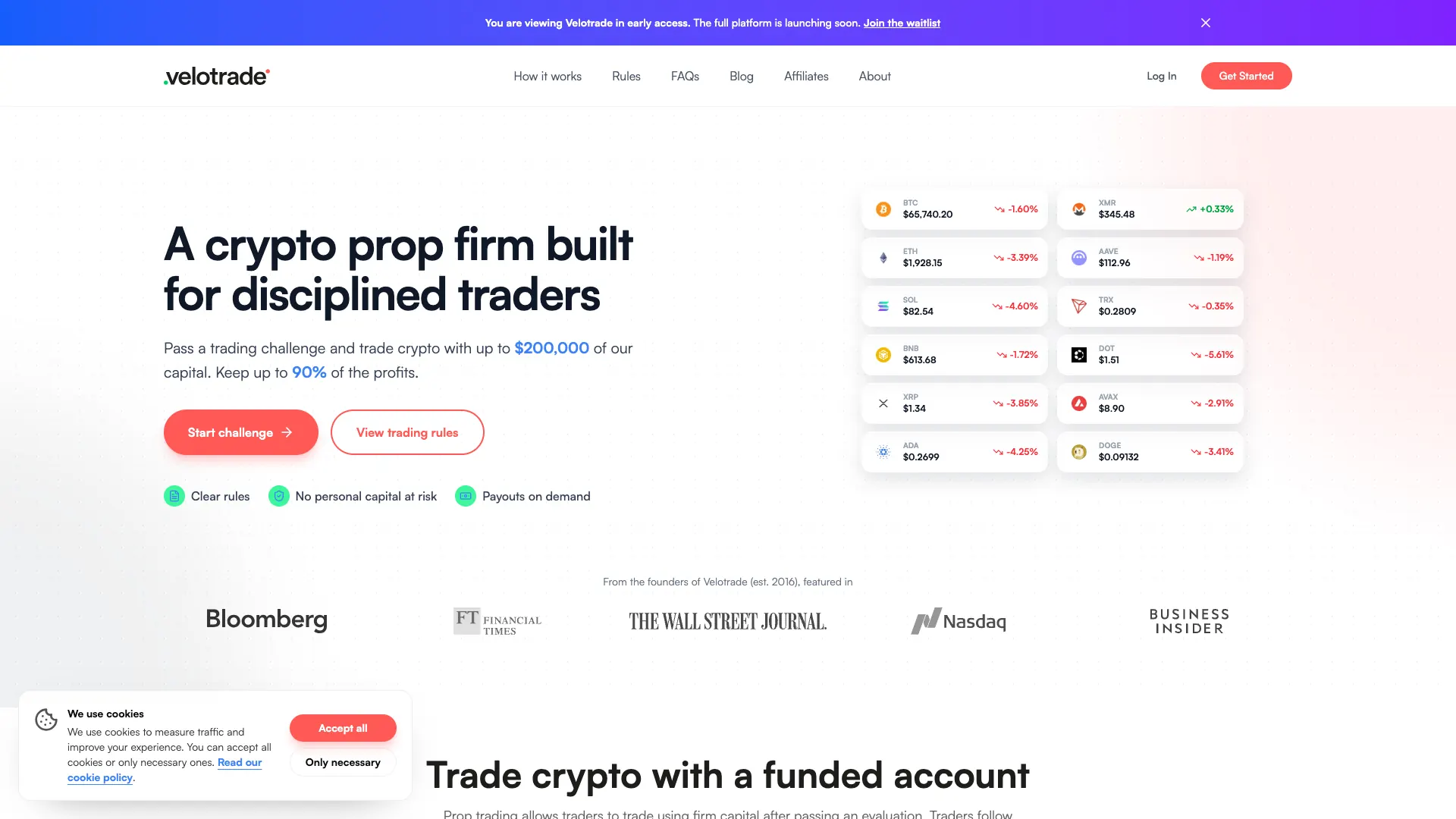
Velotrade is a multi-asset prop firm (crypto, forex, stocks, indices, commodities) built around the differentiators that matter most for newer traders.
Why it suits beginners:
- Static drawdown. The floor is fixed from the initial balance and never trails upward.
- No consistency rule. Every profitable day counts in full toward your evaluation target.
- News trading and weekend holding allowed. Fewer restrictions to accidentally breach.
- Multi-asset. Trade crypto, forex, stocks, indices, and commodities on one account.
- Full API access included on every account - run algo strategies or bots with no extra fee when you are ready to automate.
- Entry starts at $40 for a PRO 1-Step $5,000 account, or $54 for a CLASSIC 2-Step $5,000 account, allowing low-cost practice before scaling up.
Challenge structure (2-step):
| Account | Fee | Phase 1 Target | Phase 2 Target | Max Drawdown |
|---|---|---|---|---|
| $5,000 | $54 | 10% | 5% | 10% static |
| $10,000 | $100 | 10% | 5% | 10% static |
| $25,000 | $225 | 10% | 5% | 10% static |
| $50,000 | $419 | 10% | 5% | 10% static |
The 1-step format is also available with tighter drawdown limits (CLASSIC 1-Step: 7% max, 4% daily; PRO 1-Step: 3% max, 3% daily). For beginners, the 2-step at 10% max drawdown gives more room to operate during the evaluation. All drawdown is static: the floor is fixed from the initial balance.
The institutional team background (Bloomberg, JP Morgan, Bank of America, Dresdner Kleinwort, FT, WSJ, Nasdaq) means the firm was built by people who understand what real market conditions look like. The rules were designed accordingly.
Best for: Beginners who want a fair multi-asset ruleset with static drawdown - the floor is fixed from the start and never moves against you. For the full independent breakdown of Velotrade's rules, payout history, and platform, see the Velotrade review 2026.
Free calculator
How many losing trades before you breach?
See your drawdown floor, daily loss budget, and losing trade capacity for any account size - before you place a single trade.
Use the free drawdown calculator2) HyroTrader, good for beginners who want educational resources
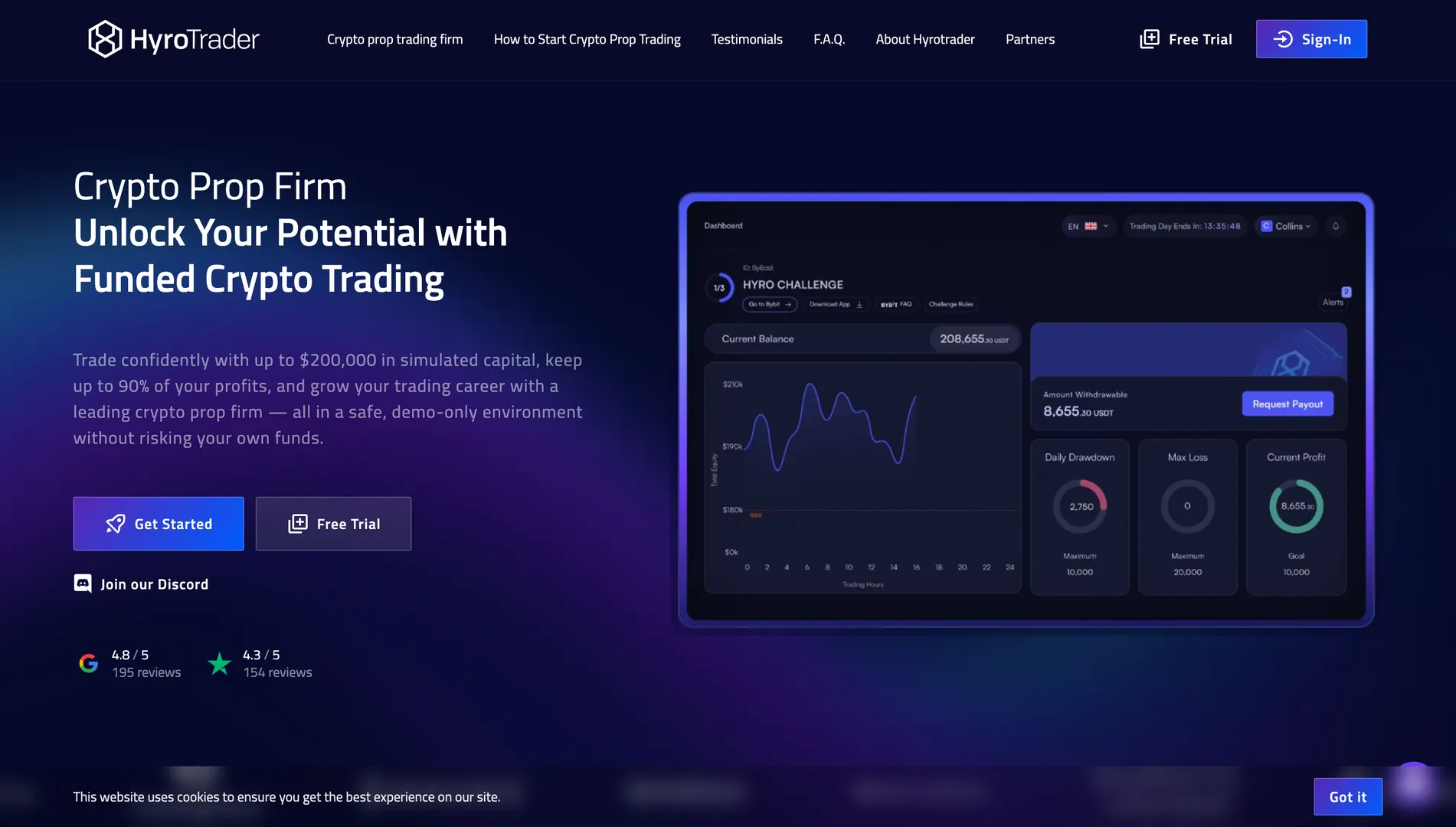
HyroTrader has invested more in educational content than most crypto prop firms. Their blog covers beginner guides, trading routines, and challenge strategies specifically aimed at newer traders. If you want to learn while you trade, they offer more structured guidance than most.
Key rules to know:
- Multiple challenge formats with varying drawdown structures. Check which model applies to your selected format.
- Consistency rule applies on some formats. Verify before purchasing.
- Crypto and some non-crypto instruments available.
For a full comparison with Velotrade, see HyroTrader vs Velotrade.
3) BrightFunded, good for beginners who prefer platform choice
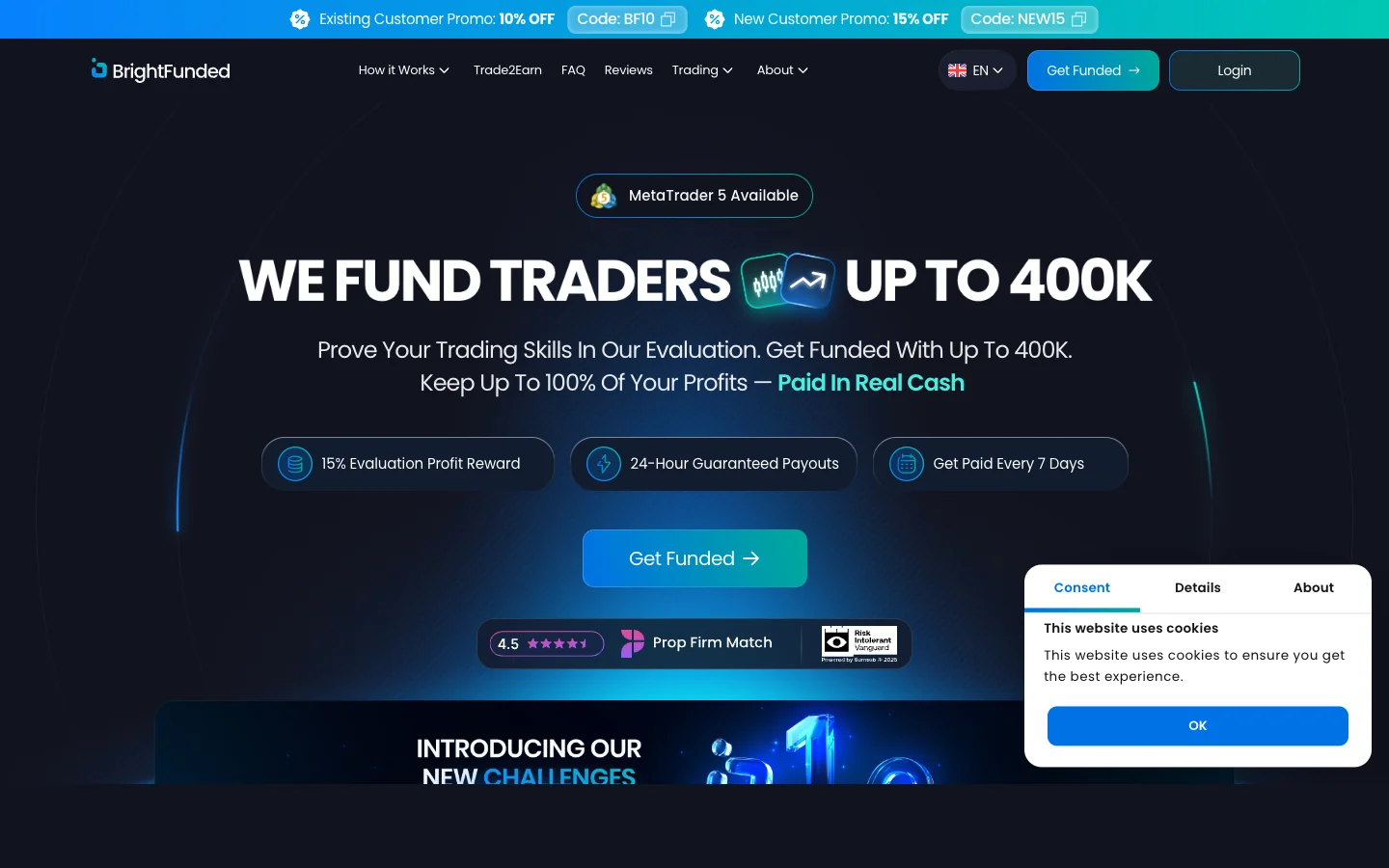
BrightFunded allows traders to choose their trading platform, which suits beginners who already have a preferred setup and do not want to learn a new interface during an evaluation.
Key rules to know:
- EOD trailing drawdown available on some formats.
- No consistency rule on evaluated formats.
- 8% Phase 1 profit target (lower than most, which reduces time pressure).
For a detailed breakdown, see BrightFunded vs Velotrade and the full BrightFunded review.
4) DNA Funded, good for beginners on tighter budgets

DNA Funded explicitly removes the consistency rule and offers lower challenge fees than some larger firms. For beginners who want to keep restart costs low while learning the rules, the lower entry point reduces the financial pressure of the learning curve.
Key rules to know:
- No consistency rule.
- Crypto-focused offering.
- Smaller firm with less established track record than more mature providers.
See DNA Funded vs Velotrade for a side-by-side comparison.
5) FundedNext, suitable for beginners focused on becoming a funded trader

FundedNext has strong educational positioning and covers the "how to become a funded trader" angle well. Their content and challenge design are aimed at traders who are working toward their first funded account.
Key rules to know:
- Consistency rule applies. A strong single day can affect evaluation validity.
- Crypto and other instruments available.
- Larger firm with an established payout history.
See FundedNext vs Velotrade for a full comparison.
Funded accounts
Start with a $5,000 or $10,000 account.
At $40-$100, restarts are manageable while you build your evaluation process.
View Velotrade challenge optionsWhat beginners should avoid
Tick-by-tick trailing drawdown
This is the single rule that eliminates the most beginners who would otherwise be capable traders. The floor moving intraday on unrealised gains means your buffer shrinks in real time during a winning trade. Beginners who do not know to account for this get stopped out of evaluations they should have passed.
Always confirm: is the drawdown calculated on closed equity at end of day, or on peak equity at any point during the session?
Large accounts as your first challenge
A $100,000 challenge feels more aspirational, but the fees are 7-20x higher and the emotional pressure of managing a larger simulated balance affects decision-making. Start small, learn the rules, then scale.
Firms with vague payout terms
As a beginner, you will eventually pass your evaluation and expect to be paid. Before purchasing a challenge, confirm: what is the payout schedule, what is the minimum withdrawal, and is there a KYC process that could delay your first payout? For the full framework, see crypto prop firm payout speed.
Firms you have not researched properly
The crypto prop firm space includes legitimate operations and a smaller number of firms that are not. Before paying any challenge fee, read the full rulebook, look for publicly verified payouts, and check whether the firm has a clear refund or dispute process. See top 5 crypto prop firm red flags and are crypto prop firms legit? before committing.
How to choose your first firm
If you are genuinely uncertain which firm to start with, work through this checklist:
- Confirm the drawdown model. EOD trailing is more forgiving for beginners than tick-by-tick. Find this in the firm's rules documentation, not the marketing copy. For a full breakdown of how all prop firm rules work in practice, see crypto prop firm rules and drawdowns explained.
- Check for a consistency rule. If it exists, understand exactly how it is calculated before trading aggressively in any single session.
- Start with a small account. $5,000-$10,000. The rules are identical to larger accounts; the cost of a restart is not.
- Run the numbers before you commit. Use the challenge ROI calculator to model your potential monthly take-home and break-even point based on account size, profit split, and expected monthly return. If maximizing your take-home matters, compare crypto prop firms with the highest profit split.
- Read how to evaluate a crypto prop firm before paying anything. The framework covers all the criteria that matter: drawdown, payouts, platform, rules, and credibility signals.
- Read how to become a funded crypto trader for a full walkthrough of the evaluation process from application to first payout.
If you are also weighing whether a prop firm makes sense at all versus trading your own capital, see crypto prop firm vs trading your own account for a direct comparison of both models.
The best first firm is the one whose rules match how you already trade. If you trade crypto or multi-asset markets, prefer clear rules, and want the drawdown model to work with you rather than against you, Velotrade is the most straightforward choice.
Disclaimer: Challenge fees and rules are subject to change. Always verify current terms directly on each firm's website before purchasing.
Frequently Asked Questions
About the author

Vittorio De Angelis
Executive Chairman
Former equity-derivatives trader at JP Morgan, Dresdner Kleinwort and Bank of America in London. Later Head of Brokerage at a global broker in Hong Kong.
Velotrade was founded in Hong Kong in 2016 by a team from JP Morgan, Dresdner Kleinwort and Bank of America, has paid out over $2.5 billion to its trade-finance clients, and has been featured in Bloomberg, the Financial Times, the Wall Street Journal and on Nasdaq. Its prop trading evaluations are simulated and educational.
View author page