
New to funded trading?
ExploreA 1-step prop firm challenge is a single evaluation phase: hit one profit target (usually 10%) without breaking the daily loss or maximum drawdown limit, and you move to a funded account. It suits disciplined traders who want speed and one fee. If you need room for mistakes, a 2-step with wider limits is usually safer.
But "1-step" describes the structure, not the difficulty. Two programs with the same 10% target can differ sharply, because one trails your drawdown floor and another keeps it fixed. This guide compares six one-step programs on the rules that actually decide whether you pass, using each firm's official pages as of October 2026, and explains where Velotrade's two 1-step plans fit and where they do not.
Highlights of this article
- A 1-step evaluation has one phase and one target, so you reach a funded account faster, but the loss limits are usually tighter than a 2-step
- The rule that separates programs most is the max drawdown type: static floors stay fixed, trailing floors move up with your profits
- FTMO, FundedNext, FundingPips, The5ers, Alpha Capital and Velotrade all run one-step programs, with different target, drawdown and consistency rules
- Velotrade has two 1-step plans: PRO 1-Step (cheapest, 3% static drawdown) and CLASSIC 1-Step (pricier, 7% static drawdown), both with no consistency rule
- If you cannot keep losing days small and predictable, a 2-step is often the cheaper route once you count retries


What is a 1-step prop firm challenge?
In a classic 2-step evaluation you pass a first phase (often an 8% to 10% target), then a second verification phase (often 5%), and only then get funded. A 1-step evaluation removes the second phase. You trade one simulated account to one target, follow the loss limits, complete any minimum trading days, and then pass to a funded account after verification.
That saves time and usually money. Firms compensate by tightening risk: where a 2-step might allow a 5% daily loss and 10% maximum drawdown, a 1-step often allows 3% to 4% daily and 3% to 7% overall.
When you compare one-step programs, look past the profit target and ask:
- How big is the maximum drawdown, and is it static or trailing? A static maximum drawdown is a fixed floor set from your starting balance. A trailing one rises with new highs, so a normal pullback after a good week can breach you.
- How is the daily loss measured? From your starting balance, from the day's opening balance, or from the higher of balance and equity.
- Is there a consistency or best-day rule? These cap how much of your total profit can come from one day.
- Is there a per-trade risk cap? Some firms limit how much you can risk on one position.
- What does the comparable account size cost, and what is the split?
Best 1-step prop firms compared (October 2026)
The table below uses the $100K account where the firm offers one, so prices are comparable. Rules and prices change often, so treat every figure as "as of October 2026" and confirm on the firm's site before you buy.
| Program | Profit target | Daily loss | Max drawdown | Consistency rule | Max risk per trade | $100K price | Split |
|---|---|---|---|---|---|---|---|
| Velotrade PRO 1-Step | 10% | 3% | 3%, static | None | None | $558 | 80%, up to 90% with add-on |
| Velotrade CLASSIC 1-Step | 10% | 4% | 7%, static | None | None | $1,075 | 80%, up to 90% with add-on |
| FTMO 1-Step | 10% | 3% | 10%, end-of-day trailing | Best day max 50% of total profit | None published | €499 list price | 90% |
| FundedNext Stellar 1-Step | 10% | 3% of initial balance | 6% of initial balance | Not stated in rules article | 3% cap on funded account | $569.99 | 80%, 90% after scale-up |
| FundingPips 1 Step Flex | 12% | 2% or 3% (you choose) | 12% overall | None | None published | Not published on rules page | 80% bi-weekly |
| The5ers Hyper Growth | 10% | 3% daily pause | 6% stop-out from initial balance | Not stated | Not stated | Not offered ($20K max per account) | Starts lower, rises with scaling |
| Alpha Capital Alpha One | 10% | 4% | 6%, trailing until it locks at starting balance | 40% best day on on-demand payouts only | Not stated | Not published on rules page | 80%, 90% with add-on |
1) Velotrade, best for a fixed drawdown floor and no consistency rule
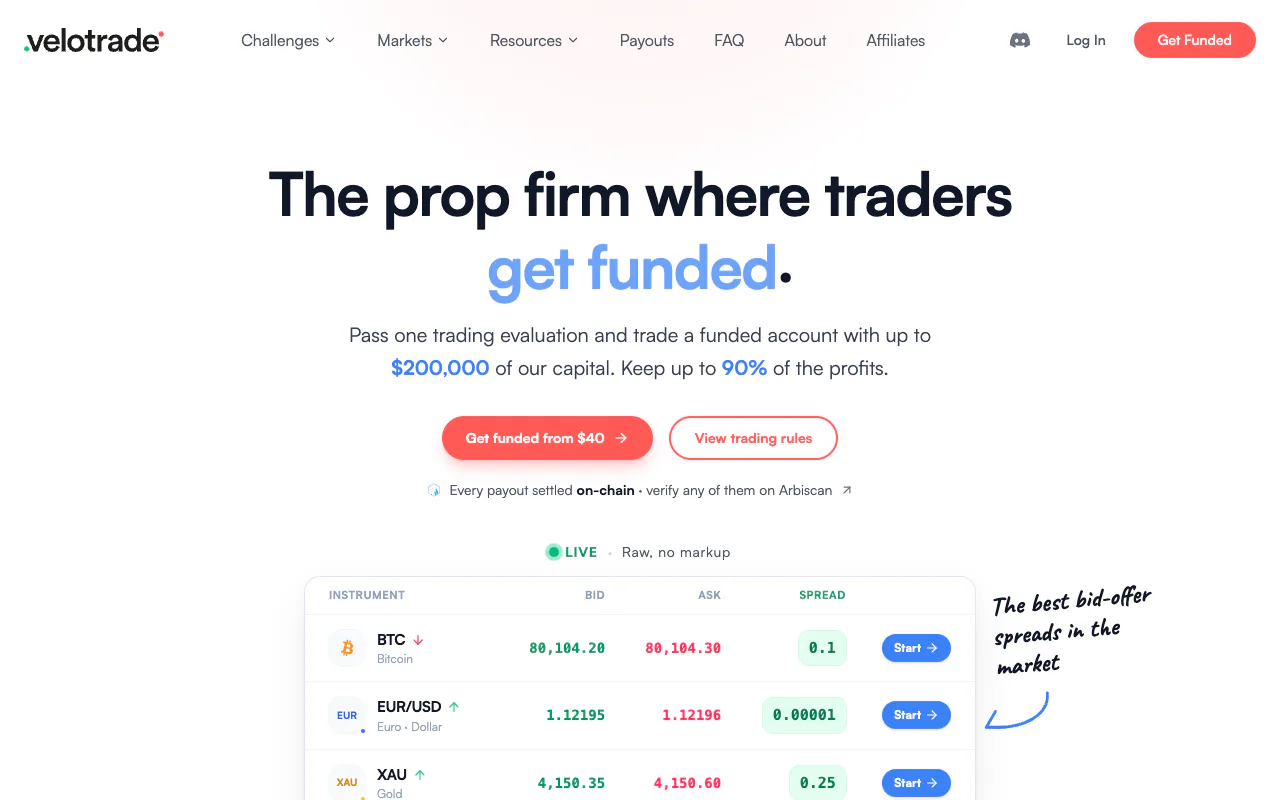
HQ: Hong Kong
Platform: DXtrade (plus REST and WebSocket API)
Max funding: Up to $200,000
Markets: Crypto, forex, stocks, index ETFs, commodities
1-step rules: PRO 10% target / 3% daily loss / 3% static max drawdown; CLASSIC 10% target / 4% daily loss / 7% static max drawdown
Velotrade's two 1-step plans both use a static maximum drawdown and have no consistency rule and no max risk per trade. You trade crypto 24/7 plus forex, index ETFs, US stocks and commodities on DXtrade, with API access for algorithms. News trading and weekend holding are allowed during the evaluation.
The daily loss limit is set from the higher of your balance or equity at 00:30 UTC, and you need a minimum of 5 trading days, with no time limit. Velotrade is not a broker and is not regulated; the challenges are simulated evaluations. The company has operated from Hong Kong since 2016.
Strengths:
- static maximum drawdown on both 1-step plans
- no consistency rule and no max risk per trade
- news trading and weekend holding allowed during the evaluation
- no time limit, 5 trading days minimum
Trade-offs:
- no CME futures and no instant funding
- payouts in USDC or USDT stablecoins, not bank wire (first payout after 14 days, then weekly, processed within 24 hours, see payouts)
- grid trading, martingale, arbitrage, tick scalping and HFT are prohibited, so check the trading rules if you run automated strategies
For a full breakdown, see Velotrade review.
2) FTMO 1-Step, best for the bigger brand with a wider (but trailing) floor

HQ: Prague
Platform: MT4, MT5, cTrader
1-step rules: 10% target / 3% daily loss / 10% end-of-day trailing max loss
FTMO's 1-Step has a 10% target, a 3% daily loss and a 10% maximum loss, with no time limit and no verification phase. The 10% buffer is wide but trails: it is recalculated daily from your highest end-of-day balance and only moves up. On a $100K account, if your balance closes a day at $104,000, the floor moves from $90,000 to $94,000.
For orders from 12 October 2026 a consistency rule caps your best day at 50% of total profit. Going over is not a breach; you keep trading until the ratio falls under 50%. The list price is €499 for $100K at the time of writing (FTMO shows fees in the currency you select at checkout, so confirm there) and the split is 90%.
Strengths:
- wide 10% maximum loss buffer
- no time limit and no verification phase
- 90% split
Trade-offs:
- the maximum loss trails your highest end-of-day balance
- best day capped at 50% of total profit for orders from 12 October 2026
For a full breakdown, see FTMO review and FTMO vs Velotrade.
3) FundedNext Stellar 1-Step, best for a moderate static-style buffer
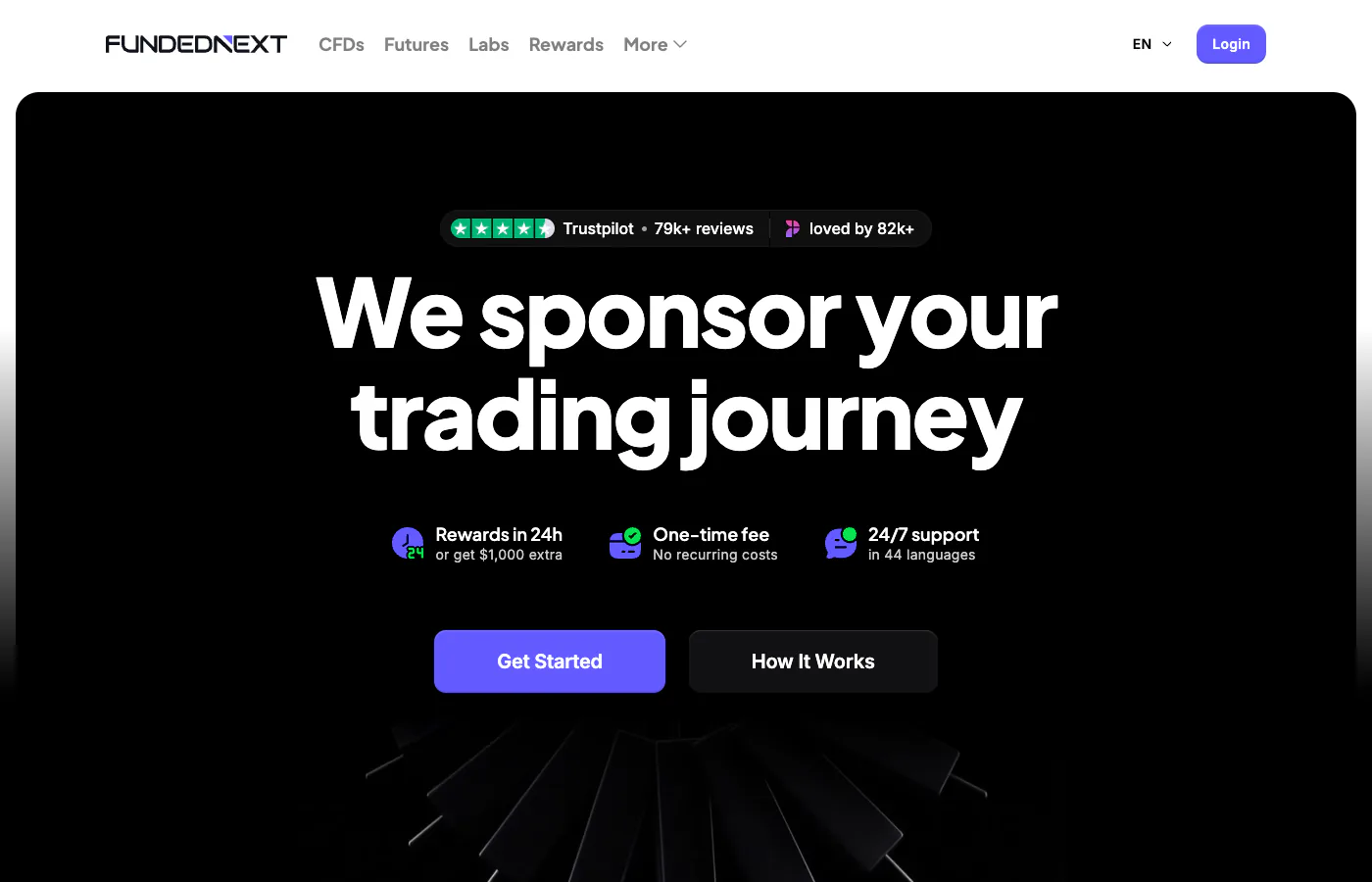
HQ: UAE
Platform: MT4, MT5, cTrader, Match-Trader
1-step rules: 10% target / 3% daily loss / 6% max loss, both from the initial balance
FundedNext's Stellar 1-Step asks for 10% with a 3% daily loss and a 6% maximum loss, both measured from the initial balance (your balance or equity must not drop below 94% of it). There is a 2-day minimum.
Once funded, you must limit risk to a maximum of 3% at any given time, and a news rule reduces profits on trades near high-impact events. Fees run from $65.99 for $6K to $569.99 for $100K, with an 80% split rising to 90% after scale-up, and a 95% add-on.
Strengths:
- loss limits measured from the initial balance
- 2-day minimum
- split rises to 90% after scale-up, with a 95% add-on
Trade-offs:
- 3% risk cap at any given time on the funded account
- news rule reduces profits on trades near high-impact events
For a full breakdown, see FundedNext review and FundedNext vs Velotrade.

4) FundingPips 1 Step Flex, best for the widest overall loss limit
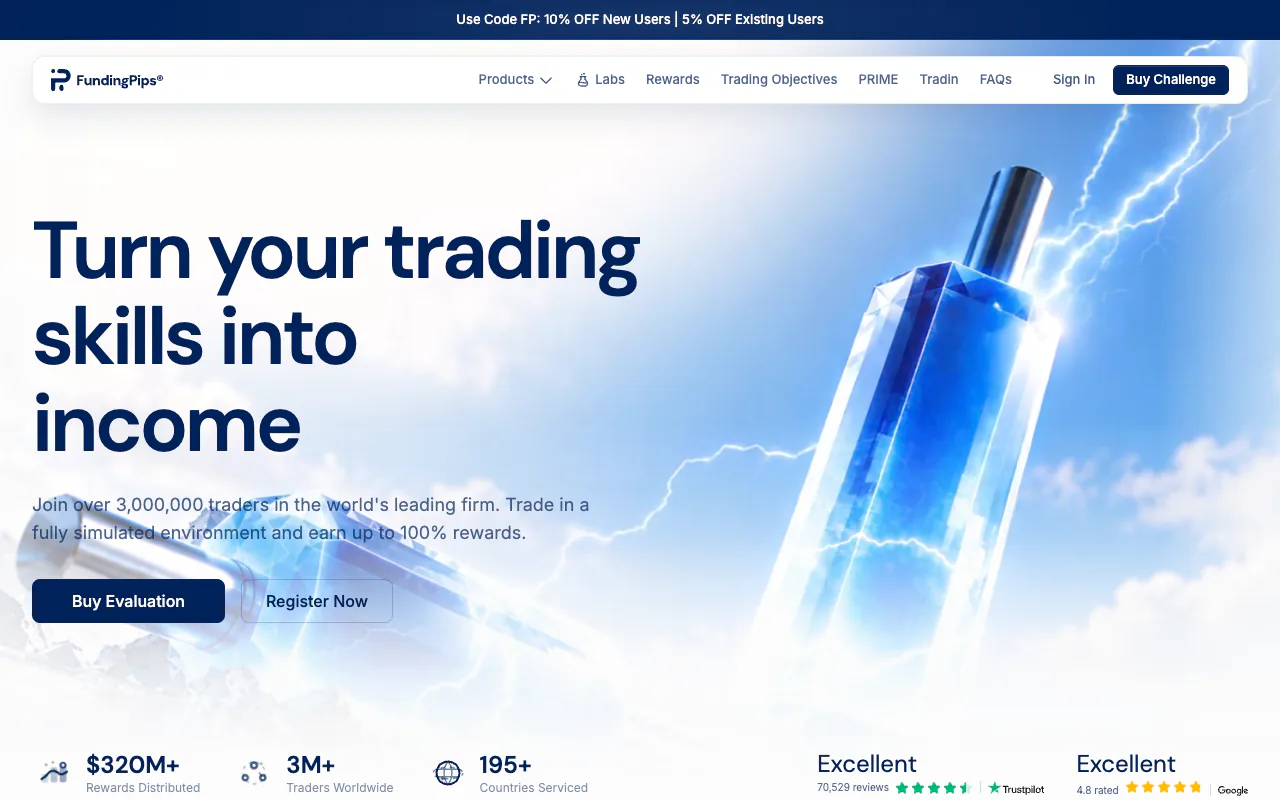
HQ: Dubai, UAE
Platform: MT5, cTrader, TradeLocker
1-step rules: 12% target / 2% or 3% daily loss (you choose) / 12% overall loss, type not stated
FundingPips' 1 Step Flex is the outlier: a higher 12% target, but a 12% overall loss limit and a choice of a 2% or 3% daily loss. There is no minimum trading day requirement and no consistency rule on the model.
After you pass, news trading is restricted and overnight or weekend holding needs a paid swing add-on. Its trading objectives page did not state whether the 12% limit is static or trailing, so confirm that before buying. The split is 80% on the bi-weekly cycle.
Strengths:
- widest overall loss limit here, at 12%
- no minimum trading days and no consistency rule
- choice of a 2% or 3% daily loss
Trade-offs:
- higher 12% target
- news trading restricted after you pass, and overnight or weekend holding needs a paid add-on
- drawdown type not stated on its trading objectives page
For a full breakdown, see FundingPips review and FundingPips vs Velotrade.
5) The5ers Hyper Growth, best for small accounts that scale

HQ: UK
Platform: MT5
1-step rules: 10% target / 3% daily pause / 6% stop-out from initial balance
The5ers' Hyper Growth is a one-step program with a 10% target and a 6% stop-out from initial balance. Its 3% daily rule is a pause, not a breach: hit it and you are suspended for the session, then return the next day.
Combined evaluation capital is capped at $40K, so there is no $100K comparison, and the account doubles at each 10% milestone. The split starts lower than most firms here and rises as you scale.
Strengths:
- the daily rule is a pause, not a breach
- the account doubles at each 10% milestone
Trade-offs:
- combined evaluation capital capped at $40K
- split starts lower than most firms here
For a full breakdown, see The5ers review and The5ers vs Velotrade.
6) Alpha Capital Alpha One, best for traders who want a trailing floor that locks
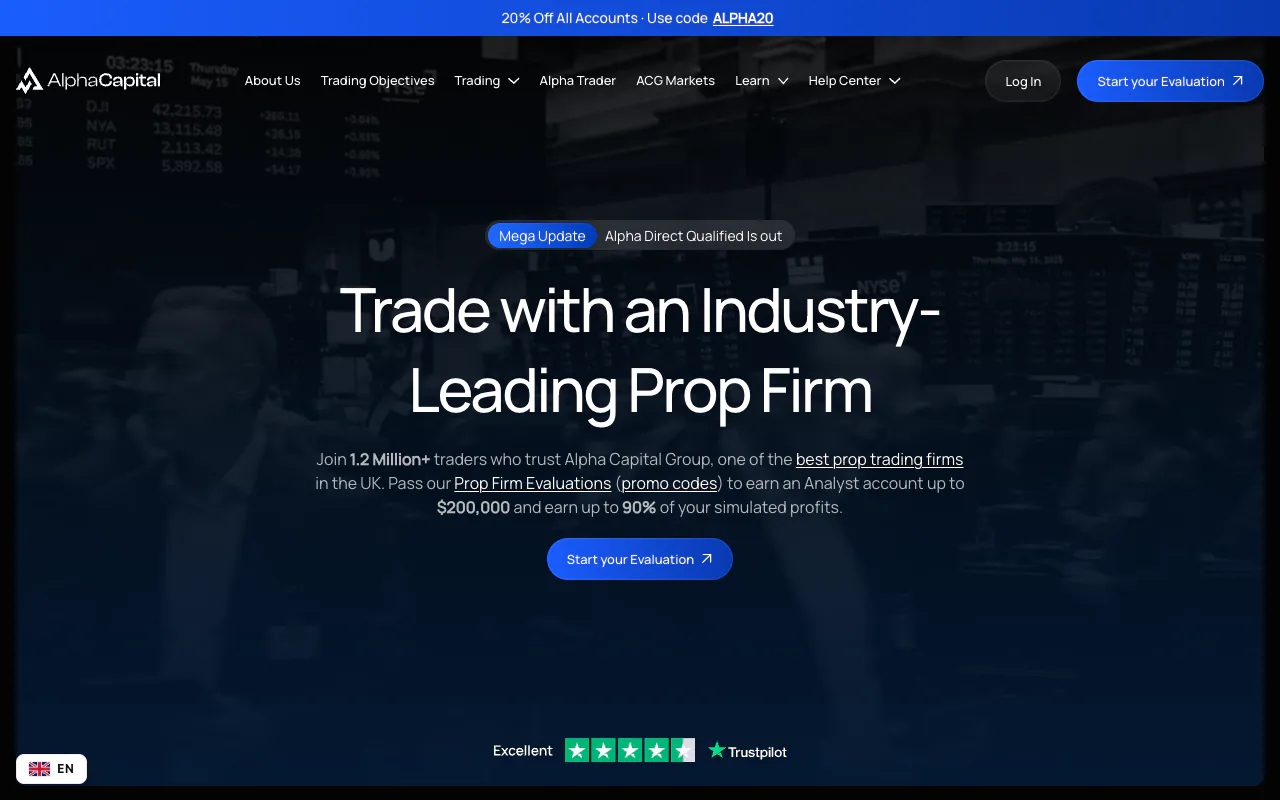
HQ: UK
Platform: MT5, cTrader, TradeLocker, DXtrade
1-step rules: 10% target / 4% daily loss / 6% trailing max drawdown that locks at the starting balance
Alpha One has a 10% target, a 4% daily loss measured from the higher of the day's opening balance or equity, and a 6% trailing maximum drawdown that locks at your starting balance once you are up 6%. On $100K, the floor starts at $94,000, rises with your balance, and stops at $100,000.
The minimum is 1 trading day. A 40% best-day rule applies only if you pick on-demand payouts. The split is 80%, or 90% with an add-on.
Strengths:
- trailing floor stops moving once it reaches the starting balance
- 1 trading day minimum
- 90% split with an add-on
Trade-offs:
- the maximum drawdown trails until you are up 6%
- 40% best-day rule if you pick on-demand payouts
Velotrade PRO 1-Step vs CLASSIC 1-Step: the honest trade-off
Velotrade sells two one-step plans, and the right one depends on how much room you need. (For the full head-to-head, read 1-Step Pro vs 1-Step Classic. This section only covers what matters when you are shopping across firms.)
| PRO 1-Step | CLASSIC 1-Step | |
|---|---|---|
| Profit target | 10% | 10% |
| Daily loss | 3% | 4% |
| Max drawdown | 3%, static | 7%, static |
| $5K price | $40 | $67 |
| $10K price | $74 | $127 |
| $100K price | $558 | $1,075 |
| Largest account | $200K ($1,114) | $100K |
Among the programs here with published prices, the PRO is the cheapest one-step entry at most sizes. The cost is a 3% maximum drawdown, which is tight. With a 10% target and a 3% floor, you need to make more than three times what you are allowed to lose, so the PRO suits traders who already cut losers quickly and size small. The CLASSIC costs nearly twice as much but gives you 7% of room, which is closer to what most one-step programs offer and far more forgiving of an ordinary losing streak.
Worked example: a $10K account
PRO 1-Step ($74):
- Profit target: $11,000 (10% of $10,000)
- Static floor: $9,700 (3% below the starting balance). It never moves, even after profitable days.
- Daily loss on day one: $300, so the daily floor is also $9,700. On a later day, if your balance or equity at 00:30 UTC is $10,400, your daily floor that day is $10,088 (3% of $10,400 is $312), while the overall floor stays at $9,700.
CLASSIC 1-Step ($127):
- Profit target: $11,000
- Static floor: $9,300 (7% below the starting balance), fixed for the life of the account
- Daily loss on day one: $400, so the daily floor is $9,600. At a $10,400 start of day, the daily floor is $9,984 (4% of $10,400 is $416).
In practice, three $100 losing days can end a PRO challenge, while the CLASSIC absorbs roughly seven. If you are unsure, the CLASSIC is the safer purchase despite the higher fee. Our guide on how to pass a 1-step crypto prop challenge covers sizing for these limits.

1-step vs 2-step: which should you pick?
Pick a 1-step if:
- You have a tested strategy with small, controlled losing days
- You want one fee and a faster route to a funded account
- You size positions so a normal losing streak stays well inside the drawdown
Pick a 2-step if:
- You are newer to evaluations or your strategy has deeper pullbacks
- You want wider limits and can accept a second, smaller target
- You would rather pay a little more time than pay for retries
At Velotrade the CLASSIC 2-Step gives a 10% then 5% target, a 5% daily loss and a 10% static drawdown, from $54 for $5K and $100 for $10K. That is cheaper than the CLASSIC 1-Step at every size, with more room, at the cost of a second phase. You can compare all three plans side by side on the challenges page.
A rule of thumb: divide the profit target by the maximum drawdown. That ratio is 3.3 on the PRO 1-Step, 1.4 on the CLASSIC 1-Step and 1.0 on CLASSIC 2-Step phase one. The higher it is, the more precise your risk control must be. Whichever you pick, price the retry, not the ticket: a $74 challenge you fail three times costs more than a $127 one you pass once. If you want the wider field, including 2-step firms, see our list of the best prop firms.
Prop-firm payouts are generally treated as income in most countries, but rules vary. This is educational information, not tax advice, so check with a local tax adviser.
To compare any two firms rule by rule, use our prop firm comparison tool.
Sources
All pages checked October 2026.
- FTMO, 1-Step Challenge
- FTMO, trading objectives
- FundedNext, Stellar 1-Step account
- FundingPips, trading objectives
- The5ers, Hyper Growth program
- Alpha Capital, rules explained
- Alpha Capital, evaluations
Last updated: October 2026. Prop firm rules, fees and drawdown models change regularly. Confirm current terms directly with each firm before buying a challenge.
Frequently Asked Questions
About the author

Vittorio De Angelis
Executive Chairman
Former equity-derivatives trader at JP Morgan, Dresdner Kleinwort and Bank of America in London. Later Head of Brokerage at a global broker in Hong Kong.
Velotrade was founded in Hong Kong in 2016 by a team from JP Morgan, Dresdner Kleinwort and Bank of America, has paid out over $2.5 billion to its trade-finance clients, and has been featured in Bloomberg, the Financial Times, the Wall Street Journal and on Nasdaq. Its prop trading evaluations are simulated and educational.
View author page