New to funded trading?
Explore all marketsUpcomers and Velotrade are closer rivals than most prop firm pairs. Both are multi-asset, both accept US traders, both allow news trading and weekend holding, and both sell one-time challenges with no subscription. The differences sit in the rules that decide whether you keep an account: how the drawdown moves, whether a best-day rule applies, how much one trade may lose, and what a payout costs.
This comparison uses each firm's own published rules and help center, read in November 2026.
Highlights of this article
- Both are multi-asset and accept US traders; Upcomers lists 1,200+ CFD symbols plus futures and perpetuals, Velotrade 234 instruments on one DXtrade account
- Most Upcomers programs use a trailing "Dynamic Risk Shield" drawdown that follows equity, open profit included; every Velotrade plan uses a static drawdown
- Upcomers funded accounts on Ash, Thunderbolt and Phoenix carry a 20% best-day rule and a 3% maximum loss per trade; Velotrade has neither
- Upcomers offers 80%, 90% or 100% splits for a higher fee; Velotrade pays 80%, or 90% with a paid add-on
- Upcomers charges payout fees ($19.90 plus 2.49% by bank); Velotrade pays in USDC or USDT
Quick Comparison: Upcomers vs Velotrade
| Upcomers | Velotrade | |
|---|---|---|
| Markets | 1,200+ CFDs (forex, indices, metals, commodities, crypto, stocks), CME futures, Hyperliquid perpetuals | 234 instruments: crypto, forex, stocks, index ETFs, commodities |
| Platforms | MT5, cTrader, TradeLocker, Match-Trader, Upcomers X | DXtrade, plus REST and WebSocket API |
| Drawdown | Mostly trailing on equity (Dynamic Risk Shield); static only on Phoenix | Static on every plan |
| Best-day rule | 20% on Ash, Thunderbolt and Phoenix funded accounts | None |
| Max loss per trade | 3% (1.5% to 2% on Horizon and Odyssey) | No cap |
| Profit split | 80%, 90% or 100%, priced at checkout | 80%, or 90% with a paid add-on |
| Payout fees | $19.90 plus 2.49% by bank | Paid in USDC or USDT |
| News and weekend | Allowed on CFDs | Allowed |
| Founded and base | 2023, Dubai | Hong Kong, team active since 2016 |
Markets and Platforms
Upcomers has the wider menu. Its CFD accounts list over 1,200 symbols across forex, indices, metals, commodities, crypto and stocks on MT5, cTrader, TradeLocker or Match-Trader at 1:100 leverage. It also sells CME futures challenges on its own Upcomers X platform and 24/7 perpetuals on Hyperliquid liquidity.
Velotrade keeps everything on one DXtrade account: crypto, forex, stocks, index ETFs and commodities, 234 instruments in all. REST and WebSocket API access comes with every account. Fewer symbols, but one platform and one rule set across all of them. See the full instrument list.
Drawdown: Dynamic Risk Shield vs Static
This is the rule that matters most. Most Upcomers programs (Ash, Thunderbolt, Horizon, Odyssey) use what it calls the Dynamic Risk Shield: a 6% maximum drawdown that trails the highest point of your equity, open profit included, until it locks at your starting balance once you are up 6%. In practice that is an intraday trailing drawdown: an open trade that runs into profit and comes back can end the account even if it closes flat. Phoenix, the 2-step program, is the exception with a static 6% maximum loss.
Every Velotrade plan uses a static maximum drawdown: 7% on the CLASSIC 1-Step, 10% on the CLASSIC 2-Step and 3% on the PRO 1-Step, fixed from your starting balance and never moving. For why this matters, see EOD trailing vs tick-by-tick drawdown.
Funded Rules: Best Day and Per-Trade Loss
Upcomers' funded Ash, Thunderbolt and Phoenix accounts apply a 20% best-day rule: no single day can be more than 20% of your profit before a payout. It is a soft rule, so it delays the payout rather than ending the account. The same accounts cap any single trade's loss at 3%. Horizon and Odyssey have no best-day rule but cap a single trade's loss at 1.5% and 2%.
Velotrade has no consistency rule and no maximum risk per trade. Your only sizing limits are the daily loss limit and the static floor. For traders whose profits come in bursts, a 20% best-day rule can hold back payouts more than any headline split.
Profit Split, Payouts and Fees
Upcomers lets you pick the split at checkout: 80% at the base price, 90% for 10% more, or 100% for 20% more. Payouts are on demand on Ash, Thunderbolt and Phoenix once you have 1% profit, and every 14 days on Horizon and Odyssey. Each payout carries a fee: $19.90 plus 2.49% by bank transfer, and by crypto $19.90 plus 30% unless more than half of your purchases were paid in crypto. Upcomers also refunds 200% of the challenge fee after your third payout on Ash, Thunderbolt and Phoenix.
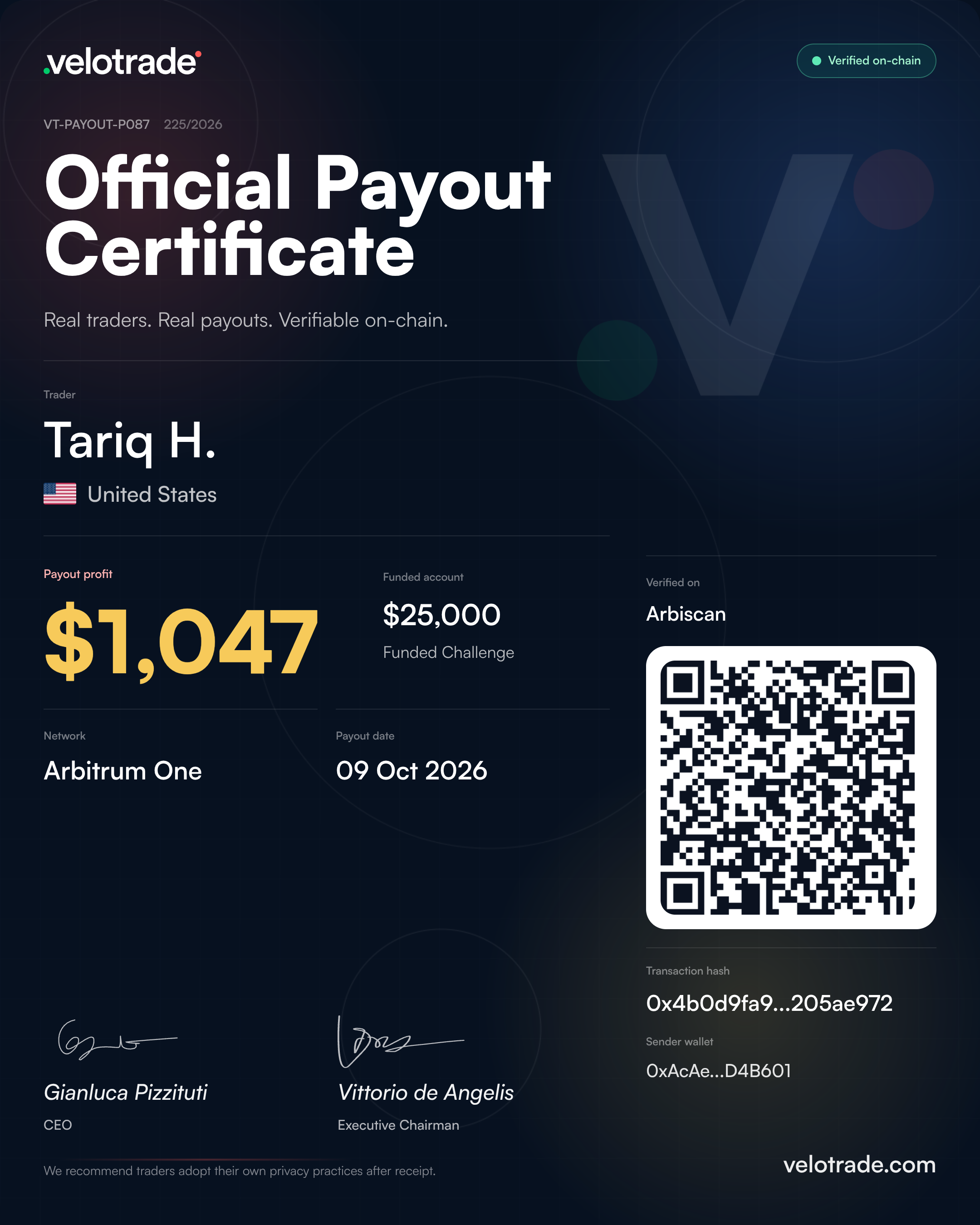
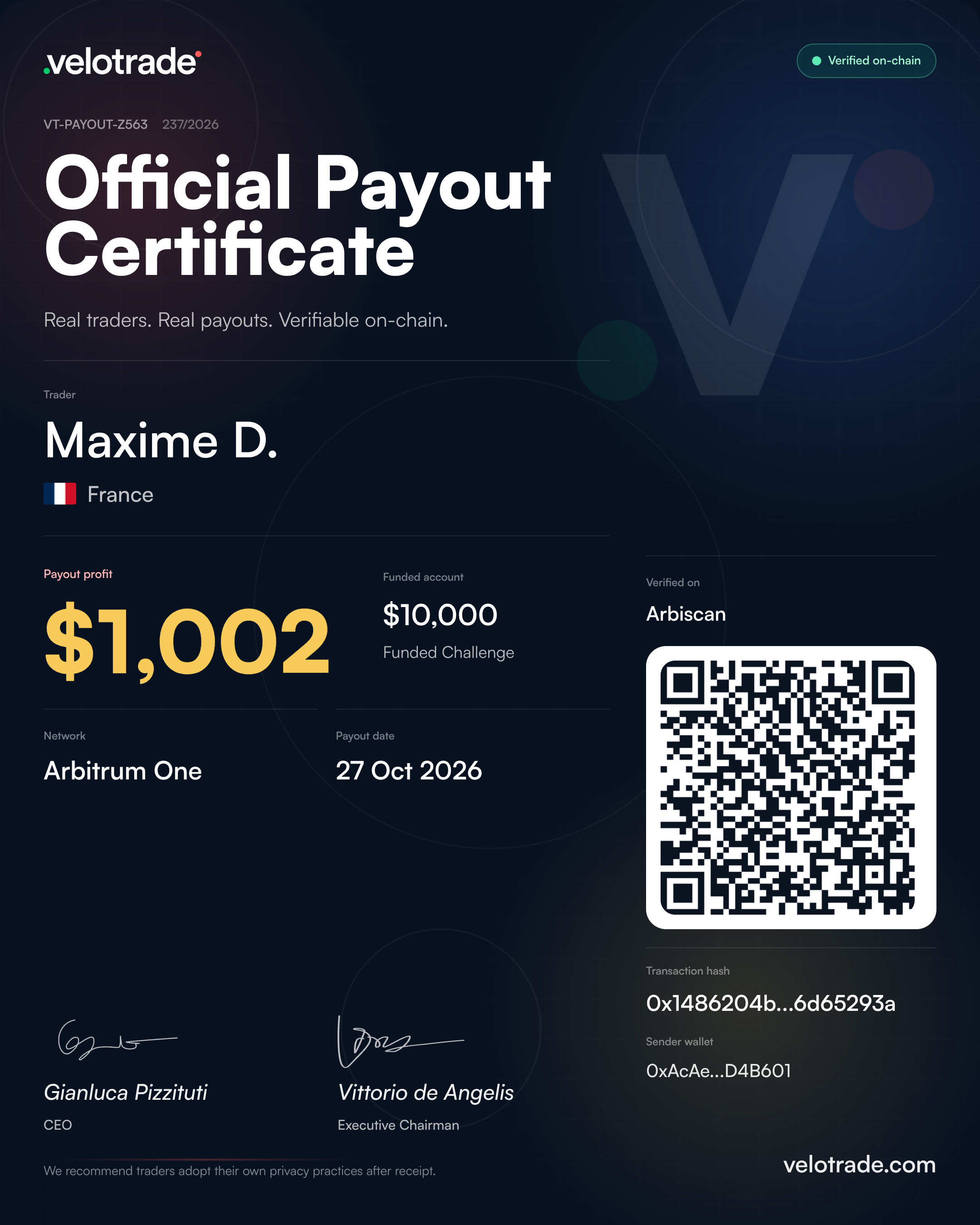
Velotrade pays 80%, or 90% with a paid add-on that applies from the first payout. The first payout comes 14 days after your first funded trade, then weekly, with a $100 minimum, in USDC or USDT. Completed withdrawals are published on the payouts page with their on-chain transactions.
Prices
Upcomers runs a large standing promotion, so its prices move often. In November 2026 its Thunderbolt 1-step started at $16.90 for a $5K account and Phoenix 2-step at $22.90 for $10K at the 80% split, shown as 90% off much higher list prices. Velotrade's PRO 1-Step costs $40 for a $5K account and scales to $200K. Both charge one-time fees with no subscription or activation fee. Compare the Velotrade challenge plans for every size, and check the live price on Upcomers' site before buying.
Who Can Join
Both accept US traders. Upcomers lists 19 restricted countries and regions, mostly sanctioned territories. Upcomers' simulated accounts are run by Royal Flow FZCO in the UAE. Velotrade is run by Velotrade Re Limited in Hong Kong. See is Velotrade legit for the company details, and prop firm red flags for the checks worth running on any firm.
Which Prop Firm Is Better?
Choose Upcomers if:
- You want MetaTrader 5 or cTrader, or the largest possible symbol list
- You want CME futures or Hyperliquid perpetuals from the same firm
- You want the option of a 100% split and accept a higher fee for it
- You trade small and steady, so a 20% best-day rule rarely bites
Choose Velotrade if:
- You want a static drawdown that never follows your open profit
- You want no best-day rule and no cap on risk per trade
- You want crypto, forex, stocks and commodities under one rule set on DXtrade
- You want API access on every account for automated trading
If you saw an Upcomers ad while searching for Velotrade, the drawdown section above is the one to read twice. For other head-to-heads, see FTMO vs Velotrade and the best multi-asset prop firms.
Velotrade is unregulated and offers educational, simulated evaluations with real-time market pricing. Upcomers also describes its accounts as simulated. Last updated: November 2026. Both firms change programs, prices and rules often, so confirm current terms on each firm's own site before buying.
Frequently Asked Questions
About the author

Vittorio De Angelis
Executive Chairman
Former equity-derivatives trader at JP Morgan, Dresdner Kleinwort and Bank of America in London. Later Head of Brokerage at a global broker in Hong Kong.
Velotrade was founded in Hong Kong in 2016 by a team from JP Morgan, Dresdner Kleinwort and Bank of America, has paid out over $2.5 billion to its trade-finance clients, and has been featured in Bloomberg, the Financial Times, the Wall Street Journal and on Nasdaq. Its prop trading evaluations are simulated and educational.
View author page