New to funded trading?
ExploreE8 Markets and Velotrade are both multi-asset prop firms that include crypto, so on the surface they look like close cousins. The difference that decides which one fits you is the rule set. E8 is built around a highly customizable account-builder but layers on a drawdown that varies by model (E8 One, Signature, and Zero trail on the funded stage; only E8 Zero is static) and a consistency rule, while Velotrade keeps a simpler, more predictable model: a static drawdown fixed from your starting balance on every plan, no consistency rule, and crypto-native 24/7 execution.
This comparison puts the two side by side on what actually changes your odds of passing and getting paid: how the drawdown is calculated, whether a best-day rule caps your profit, how each handles crypto, and what the split, fees, and platforms look like.
Quick answer: E8 Markets suits traders who want account-builder flexibility across forex, futures, and crypto, and who are comfortable with a drawdown that varies by model (E8 One, Signature, and Zero trail; E8 Pro static) plus a 40% consistency rule (35% on Signature). Velotrade suits traders who want a static drawdown that never trails, no consistency rule, no maximum risk per trade, and crypto-native 24/7 trading, with the profit split included rather than sold as an upgrade. Neither is strictly better; the right pick depends on whether you value customization or a simpler, more forgiving rule set.
Highlights of this article
- Both firms are multi-asset and include crypto, so the decisive difference is the rule set, not the asset menu
- E8's drawdown varies by model (E8 One, Signature, and Zero dynamic or EOD trailing, E8 Pro static); Velotrade uses a static drawdown fixed from your starting balance on every plan
- E8 applies a consistency, or best-day, rule (40%, 35% on Signature); Velotrade has no consistency rule at any stage
- E8's split runs up to 100% (80/90/100% tiers, higher tiers paid); Velotrade applies up to 90% with the split included
- E8 has a longer track record (over $68M paid to 18,900-plus traders, Trustpilot about 4.3); Velotrade launched its crypto prop product in 2026
- Velotrade is crypto-native and 24/7 with no maximum risk per trade; E8's crypto access is CFD-style and not exchange-native
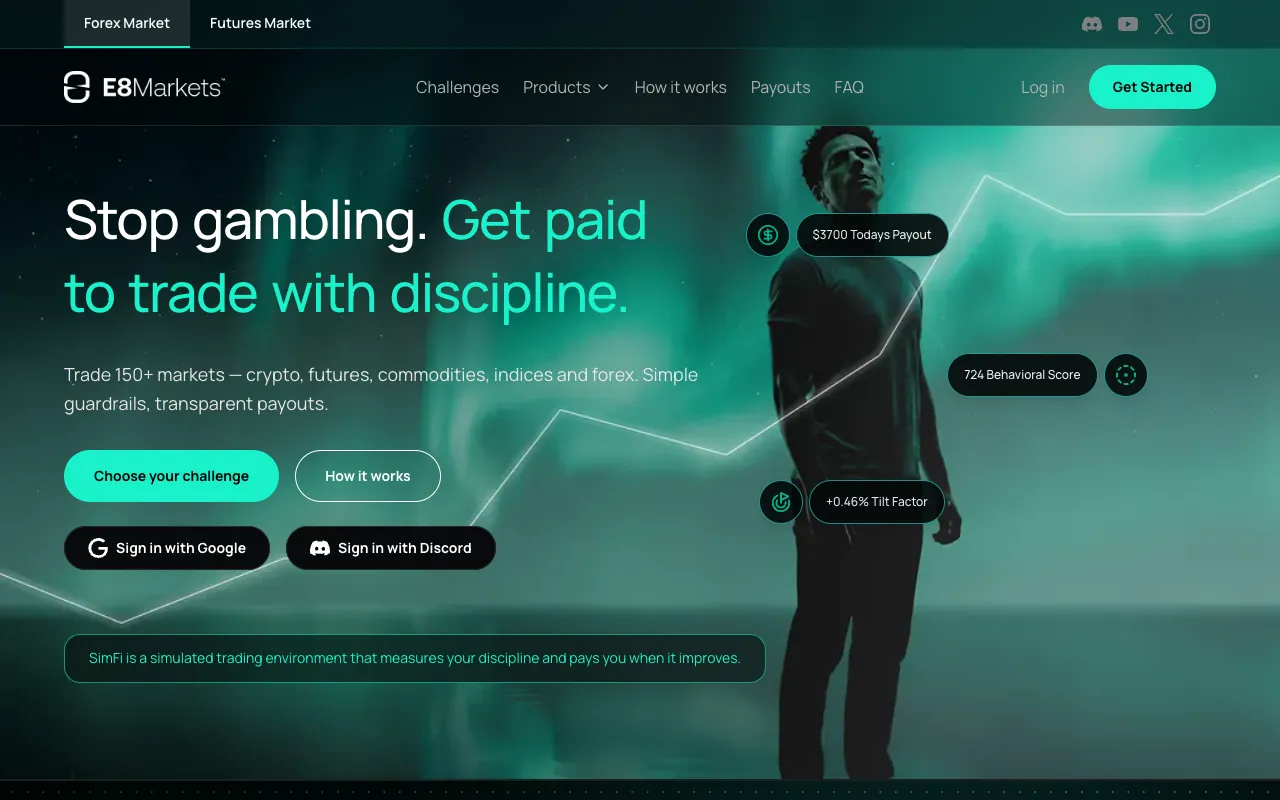
Quick Comparison: E8 Markets vs Velotrade
| E8 Markets | Velotrade | |
|---|---|---|
| Markets | Forex, futures, crypto, commodities, indices (150-plus) | Crypto-first; forex, stocks, indices, commodities |
| Drawdown model | Varies by model: E8 One, Signature, and Zero dynamic/EOD trailing (about 4 to 14% on E8 One) plus a daily limit; E8 Pro static | Static on every plan, fixed from starting balance, never trails |
| Consistency rule | Funded stage: 40% best day (E8 One), 35% (Signature); none on E8 Pro | None |
| Profit split | Up to 100% (80/90/100% tiers, higher tiers paid) | Up to 90%, included |
| Payouts | After 14 days, 5 profitable days at 0.3% each | Up to 90% from first payout |
| Platforms | Customizable at checkout; Tradovate for futures | DXtrade |
| Track record | Since multi-year, $68M-plus paid, Trustpilot ~4.3 | Since 2026 (crypto prop launch) |
Drawdown: Trailing vs Static
This is the central difference between the two firms. E8's drawdown varies by model: E8 One, Signature, and Zero use a dynamic or end-of-day dynamic drawdown that moves up with closed profits until it reaches the starting balance, while E8 Pro uses a static one. On E8 One the trailing drawdown runs roughly 4 to 14% depending on the build you choose at checkout, stacked on top of a 3% daily limit. A trailing drawdown moves with your equity: as your balance climbs, the floor climbs behind it, so a pullback from a peak can breach your account even while you are still up on the day you started. The daily limit resets each morning based on the prior day's close.
Velotrade uses a static maximum drawdown on every plan (2-Step 10%, 1-Step 7%, Pro 3%), where the loss floor is fixed from your starting balance and never trails up against you. That is the more forgiving model in volatile markets, because a winning run does not tighten the noose behind you. You always know exactly where your floor sits, from day one to withdrawal.
For most traders this is the single most important line in the comparison. If you tend to run profits up and then give some back, a trailing floor can end a challenge that a static floor would have survived. To understand why the calculation method matters as much as the percentage, see static maximum drawdown explained and EOD trailing vs tick-by-tick drawdown.
Consistency Rule: E8's Best-Day Rule vs None
E8 applies a consistency, or best-day, rule: on E8 One's funded stage your single strongest trading day cannot exceed 40% of your total profit, tightening to 35% on Signature funded accounts; E8 Pro has no best-day rule. The practical effect is that one big day can force you to keep trading, at risk, just to dilute that day's share before you qualify to withdraw. It is a genuine discipline mechanism, and it is also a recurring reason traders report a delayed first payout.
Velotrade has no consistency rule at any stage. If your edge concentrates returns on a few sessions, you can take those days without a cap forcing you back into the market to average them down. For traders whose profits are lumpy by nature, which describes a lot of crypto strategies, this removes a real obstacle to getting paid on your own timeline. For more on this rule and which firms skip it, see best crypto prop firms.

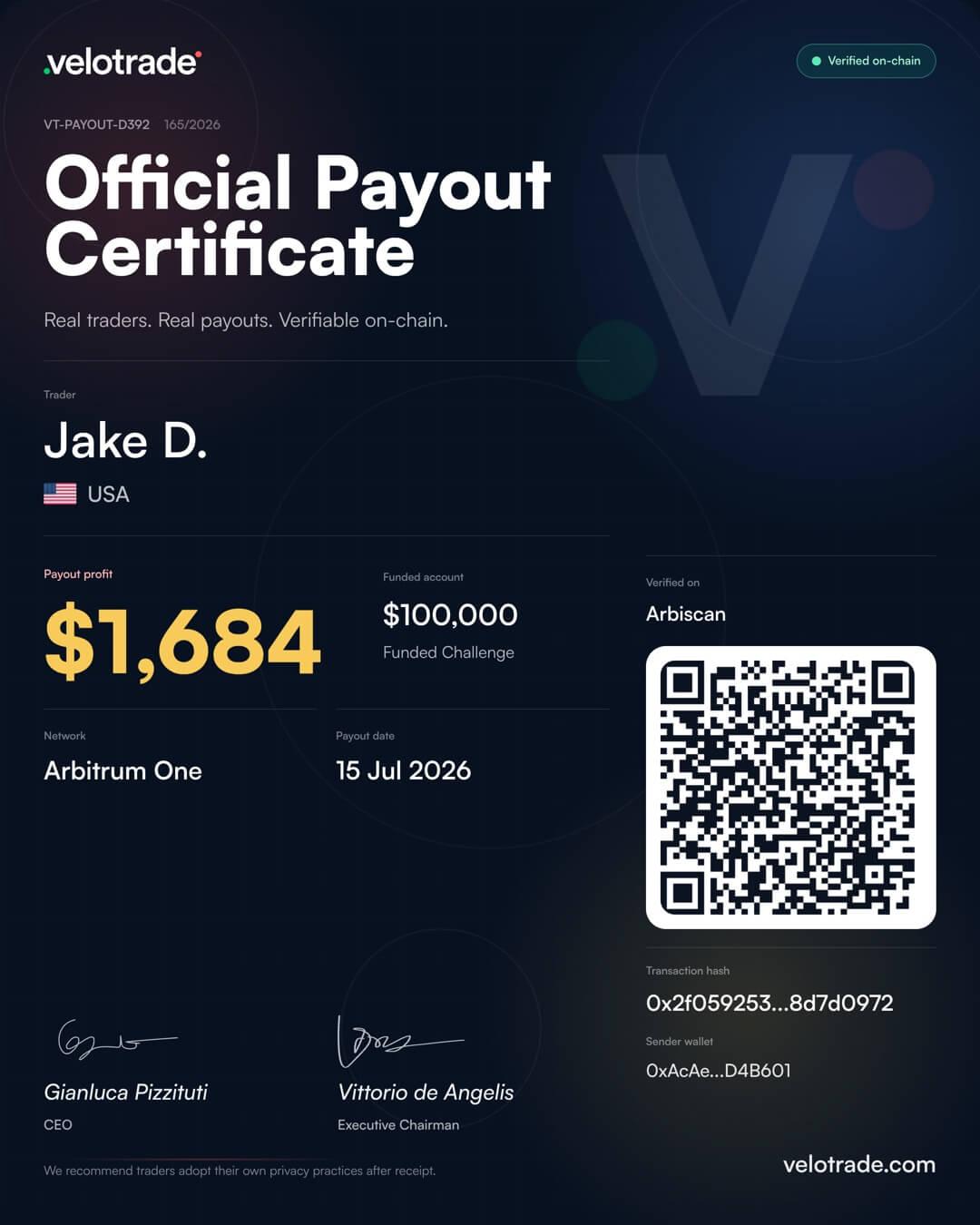
Payout proof
Fast, real payouts. Traceable on Arbitrum.
- Paid within 24 hours of approval
- Settled on Arbitrum in USDC or USDT
- Look up any transaction on Arbiscan

Markets and Crypto-Native Execution
Both firms are genuinely multi-asset, which is what makes this a fair fight rather than a mismatch. E8 covers forex, futures, crypto, commodities, and indices across more than 150 markets, with futures added in 2026 via Tradovate. Its crypto access, though, is CFD-style rather than exchange-native, and it is not traded around the clock like a dedicated crypto venue.
Velotrade is crypto-first and built for the 24/7 market. Trading runs continuously, weekend holding is not a special case, and there is no maximum risk per trade or lot-size cap. For a trader whose primary market is crypto, that always-on, exchange-native design matches how the asset actually trades. E8 is the broader menu if you split time across futures and forex; Velotrade is the sharper tool if crypto is the center of your strategy.
Profit Split, Fees, and Payouts
E8's profit split runs up to 100%, offered as 80/90/100% tiers, with 90 and 100% a paid add-on layered onto the challenge fee, so the cheapest entry and the highest split are not the same purchase. Because E8 One is configurable, there is no single price list: the fee moves with account size, the drawdown you pick, and the split tier. A representative $5,000 default build runs around $48 before discounts, and account sizes reach $500,000 on forex and $200,000 on crypto. Payouts open after your first 14 days, once you have stacked 5 profitable days at 0.3% profit each.
Velotrade applies up to 90% with the split included rather than sold as a tier you pay to unlock, and there is no consistency rule to dilute before you withdraw. So the headline is straightforward: at E8 the top split is a paid upgrade, while at Velotrade it is part of the base offer.
Platforms
E8 lets you choose your platform at checkout as part of the account-builder, and it added Tradovate for its futures track in 2026, so you can match the platform to the asset you trade. Velotrade runs on DXtrade, a single platform that keeps the rule set and interface consistent across every asset you trade with the firm.
If platform choice matters to you, especially if you want a specific futures front-end, E8 has the edge. If you are happy on DXtrade, Velotrade's single-platform focus means one consistent environment with no per-asset quirks to learn.
Track Record and Background
E8's longer history is a real point in its favour. Operating as E8 Funding LLC in the US, it reports more than $68 million paid to over 18,900 traders and holds a Trustpilot rating of about 4.3 out of 5 across roughly 3,270 reviews, which is solid for a firm of its size. The recurring complaints cluster around rule complexity, spreads, and the best-day rule delaying a first payout, rather than around withheld money, so treat it as legitimate but read the fine print.
Velotrade's counterpoint is a documented institutional team background (JP Morgan, Dresdner Kleinwort, Bank of America) and a rule set built specifically for crypto, though its crypto prop product launched in 2026 and so has less accumulated public payout history. Where E8 leads on operating history and payout proof, Velotrade leads on crypto-native rules and team transparency. For the deeper profile, see the E8 Markets review.
What Each Firm Suits Best
Choose Velotrade if:
- You want a static drawdown that never trails against a winning run
- You want no consistency rule
- You trade crypto and want 24/7, exchange-native execution
- You want no maximum risk per trade and the profit split included, not sold as an upgrade
Choose E8 Markets if:
- You want account-builder flexibility across forex, futures, and crypto
- You are comfortable with a trailing drawdown on most models (E8 One, Signature, and Zero) and a 40% best-day rule
- You value a longer public payout record ($68M-plus paid, Trustpilot about 4.3)
- You want to pick your platform, including a futures front-end via Tradovate
Which Prop Firm Is Better?
There is no single winner. E8 wins on flexibility and proof: an account-builder that tunes drawdown, split, and platform to your style, a broad multi-asset menu, and a longer public payout record. Velotrade wins on a simpler, more forgiving rule set: a static drawdown that never trails, no consistency rule, no maximum risk per trade, and crypto-native 24/7 trading with the split included.
Decide on how you trade. If you want customization across asset tracks and can work within a trailing drawdown and a best-day rule, E8 is the more configurable package with more history behind it. If you trade crypto or want the most predictable, forgiving floor with no consistency cap, Velotrade's challenge plans are the cleaner fit. Verify the current terms directly before purchasing either.
For the wider market, see top prop firms in 2026 and check your odds of passing first with the challenge pass calculator.
Free calculator
What does passing actually pay you?
Plug in your account size and see your profit target, max drawdown, and first payout - before you commit to a challenge.
Use the free prop challenge calculatorFrequently Asked Questions
About the author

Vittorio De Angelis
Executive Chairman
Former equity-derivatives trader at JP Morgan, Dresdner Kleinwort and Bank of America in London. Later Head of Brokerage at a global broker in Hong Kong.
View author page