Trade crypto with funded capital
ExploreThe primary crypto market is where new digital assets are first issued and distributed. The secondary crypto market is where those assets are traded between participants after issuance. For most crypto prop traders, the secondary market is the only market they ever interact with. Understanding how both work changes how you interpret price action, liquidity, and risk.
Highlights of this article
- The primary crypto market is where new assets are first issued: ICOs, IEOs, new exchange listings, new futures contracts
- The secondary crypto market is where those assets are traded between participants after issuance
- All crypto prop trading happens in secondary markets, specifically perpetual futures and spot pairs
- Secondary market liquidity, funding rates, and time-of-day conditions directly affect how prop traders manage funded accounts
- Velotrade funded accounts trade crypto derivatives in the secondary market, where institutional-grade liquidity is deepest
What is the primary crypto market?
The primary crypto market is the first point of sale for a new asset. When a cryptocurrency, token, or derivative contract is introduced to the market for the first time, that initial transaction happens in the primary market.
Examples of primary market activity in crypto:
- ICO (initial coin offering): New tokens are sold directly to early buyers before any secondary exchange listing. The project receives the capital. Buyers receive tokens that cannot yet be traded on an exchange.
- IEO (initial exchange offering): A crypto exchange facilitates the first sale of a new token on its platform. The exchange acts as a gatekeeper and receives a share of proceeds.
- New spot pair listing: When Binance lists a new token pair for the first time, the initial provision of liquidity and the first matched trades represent primary market activity.
- New futures contract launch: When an exchange introduces a new perpetual futures contract, the first open interest created represents a primary market event. All subsequent trading between longs and shorts happens in the secondary market.
In every case, the issuer (a project, exchange, or protocol) receives proceeds from the initial transaction. Buyers are acquiring an asset that did not exist as a tradeable instrument before.
What is the secondary crypto market?
The secondary crypto market is where existing crypto assets trade between participants after their initial issuance. This is where the overwhelming majority of global crypto volume occurs.
When you buy BTC on Coinbase or sell ETH perpetuals on Binance, you are trading in the secondary market. You are buying from another participant who already holds those assets. The exchange is not issuing new Bitcoin. It is matching your order against a counterpart.
Perpetual futures contracts are secondary market instruments by nature. Once an exchange launches a contract (a primary market event), all subsequent trading happens between longs and shorts in the secondary market. There is no new asset issuance for each trade. Positions change hands. Funding payments flow between participants. Price discovery happens continuously.
The secondary market is where all price action occurs. Every chart you read, every support and resistance level, every Wyckoff accumulation range, every orderbook snapshot: these are secondary market phenomena.
Primary vs secondary crypto market: key differences
| Factor | Primary Market | Secondary Market |
|---|---|---|
| What is traded | Newly issued assets | Existing assets between participants |
| Counterparty | Issuer (project, exchange, protocol) | Other traders |
| Purpose | Capital raising, new instrument creation | Price discovery and liquidity |
| Common instruments | ICOs, IEOs, new token launches, new futures contracts | Spot pairs, perpetual futures, options |
| Frequency | Rare, event-driven | Continuous, 24/7 |
| Price setting | Fixed by issuer or auction | Real-time supply and demand |
| Who participates | VCs, institutions, early buyers | All traders, retail and institutional |
| Relevance to prop traders | Minimal | Directly relevant |
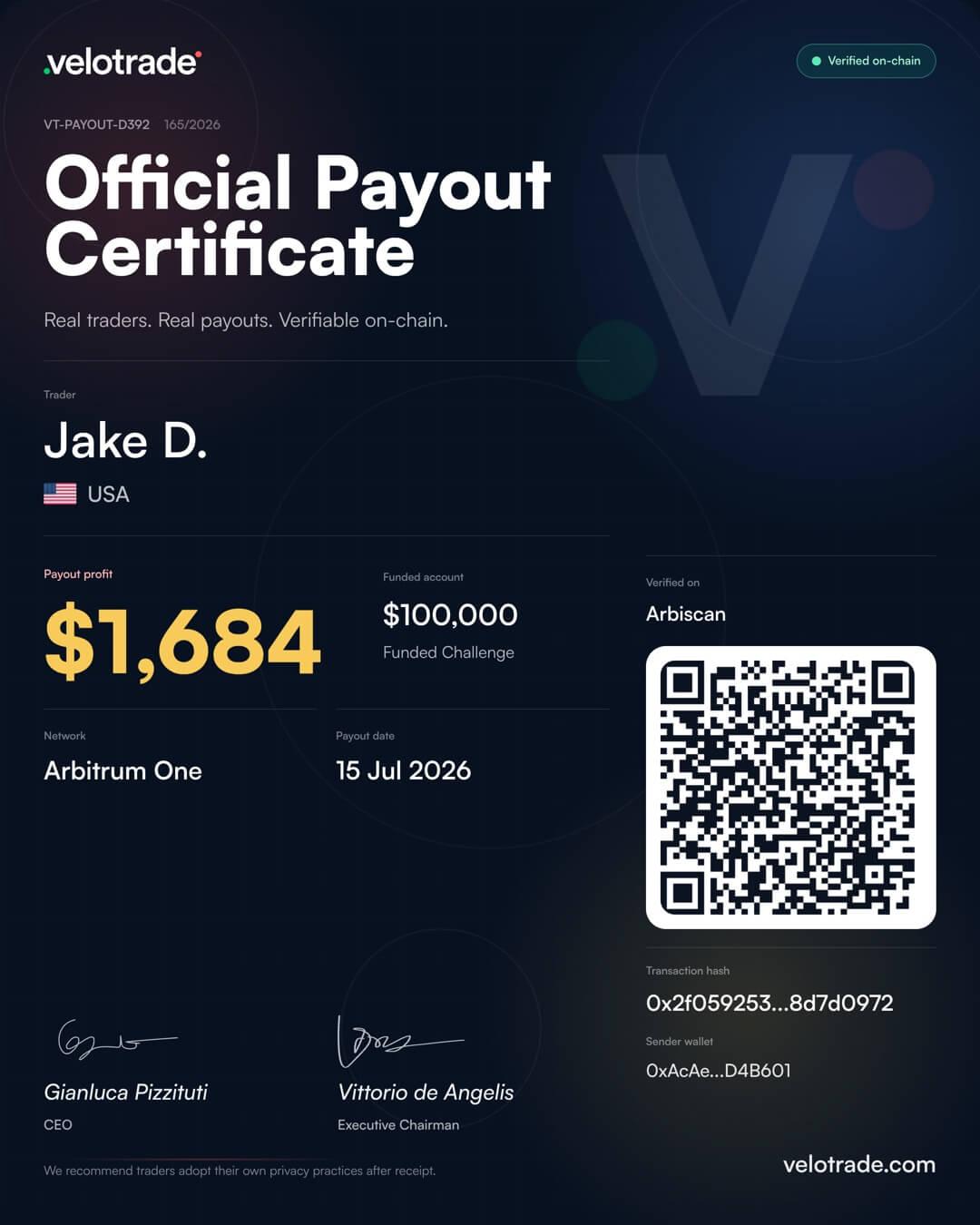
Payout proof
Fast, real payouts. Traceable on Arbitrum.
- Paid within 24 hours of approval
- Settled on Arbitrum in USDC or USDT
- Look up any transaction on Arbiscan

Where crypto prop trading fits
All crypto prop trading happens in secondary markets. When a trader executes a position on a Velotrade funded account, every trade is a secondary market transaction, typically a perpetual futures contract on BTC, ETH, or another liquid pair.
Crypto prop firms do not use funded trader capital to participate in ICOs, IEOs, or primary token sales. The evaluation process, the funded account, and the drawdown rules are all calibrated for secondary market conditions: the volatility profile of perpetual futures, the liquidity depth of major venues, and the 24/7 trading environment.
Understanding this has two practical implications for prop traders:
First, liquidity matters differently in secondary markets. Secondary market liquidity is not fixed. It varies by pair, by venue, by time of day, and by market conditions. BTC/USDT perpetuals on major exchanges have deep, liquid orderbooks. Small-cap altcoin pairs do not. Prop traders who assume uniform liquidity across instruments are taking on invisible execution risk.
Second, secondary market structure drives volatility. Price moves in the secondary market are produced by the interaction of participants: spot traders, perpetual futures traders, arbitrageurs, market makers, and institutional hedgers. Understanding who is active and when provides context for why volatility clusters at certain times and why certain price levels behave as they do.
Why secondary market liquidity matters for funded accounts
Liquidity in secondary markets directly affects how you manage a funded account. Three practical areas:
Position sizing relative to market depth
On deep secondary markets such as BTC and ETH perpetuals on major venues, retail prop trading position sizes do not meaningfully move prices. Execution is efficient and slippage is minimal.
On thinner markets such as small-cap altcoins, newly listed contracts, or less popular pairs, large positions create their own price impact. Entry and exit cost more. Spreads are wider. This creates hidden risk that does not appear in the profit target calculation but shows up in actual P&L.
Prop traders operating under drawdown rules should match position sizing to available secondary market liquidity. Sizing up in a thin market amplifies both drawdown risk and execution cost simultaneously.
Liquidity windows and time of day
Secondary market liquidity in crypto concentrates in three daily windows:
| Session | Approximate UTC | What happens |
|---|---|---|
| Asian open | 00:00 - 06:00 | Moderate activity, major pairs liquid, altcoins less so |
| European open | 07:00 - 12:00 | Liquidity increases, overlaps with Asian close |
| US open | 13:00 - 21:00 | Highest volume, tightest spreads, most volatility |
Entering large positions during off-hours, particularly the 21:00-00:00 UTC window, increases execution cost. Spreads widen. Orderbook depth thins. For a funded account with a tight daily loss limit, the difference between entering a trade during US hours versus off-hours can represent a meaningful fraction of the daily buffer.
Funding rates and position hold costs
Perpetual futures in the secondary market use funding rate mechanisms to keep the contract price anchored to spot. When perpetuals trade at a premium to spot, longs pay shorts. When they trade at a discount, shorts pay longs. Payments typically occur every 8 hours.
Free calculator
Is prop trading worth it for you?
Enter your account size, expected monthly profit, and how many attempts to pass. See your break-even month and 12-month net in seconds.
Use the free ROI calculatorFor prop traders holding positions overnight or across multiple days, funding accumulates and reduces net P&L on the funded account. In strong trending markets, funding rates on the dominant direction can be significant, sometimes 0.1% or more per 8-hour period. On a $100,000 funded account with a leveraged long position during a BTC bull run, that funding cost is real and needs to be factored into the position's expected return.
The 24/7 secondary market and prop trading advantages
One structural advantage of crypto secondary markets is that they never close. Unlike equities (closed nights and weekends) or forex (closed weekends), crypto spot and perpetual markets are active continuously.
This creates specific advantages for prop traders:
Weekend holding is possible. Firms that allow weekend holding, Velotrade among them, let traders hold positions through weekend moves. There are no forced closures at Friday end-of-day. A position can capture a Sunday night BTC rally without requiring a re-entry on Monday.
No gap-up/gap-down risk at session open. Equities traders deal with overnight gaps: stock prices jump at open due to news that occurred when markets were closed. In crypto secondary markets, price discovery is continuous. News events cause immediate moves rather than accumulated gap risk.
Risk management runs 24 hours. At Velotrade, the daily loss limit resets at 00:30 UTC every day and is monitored against live equity at all times, including overnight and on weekends. There is no pause in the drawdown clock. Low-liquidity overnight sessions carry elevated slippage risk if a stop is triggered. Awareness of when secondary market liquidity thins is part of funded account risk management.
How prop firms interact with secondary markets
A crypto prop firm operates in the secondary market on two levels:
Funded trader activity: Traders holding funded accounts execute buy and sell orders in secondary market pairs. Position sizes are subject to the firm's risk rules and the leverage available on the trading platform.
Institutional hedging: Some prop firms manage their net exposure across all funded trader positions by hedging in deep secondary market venues. When many funded traders hold the same directional position, the firm may hedge net exposure in the institutional secondary market. This is separate from funded trader activity and does not affect individual account management.
Velotrade's institutional background is relevant here. The founding team comes from Bloomberg, JP Morgan, and other institutional venues. The firm's ability to interact with deep institutional secondary markets for hedging purposes means the funded trading model is not purely fee-dependent. The best crypto prop firms differentiate themselves partly by how they manage their own secondary market exposure.
What this means before you open a funded account
Understanding secondary market structure gives prop traders a clearer framework for two pre-evaluation decisions:
Which instruments to trade: Focus on instruments with deep secondary market liquidity. BTC and ETH perpetuals on major exchanges are the right starting point. Chasing smaller-cap pairs with thinner books amplifies execution risk in an environment where drawdown rules already demand tight risk management.
When to trade: Time-of-day liquidity patterns are predictable. Aligning your most active trading with the US session and European-Asian overlap reduces execution cost and increases the reliability of technical levels. Trading during low-liquidity hours should be deliberate: either because a setup requires it or because you are managing an existing position, not entering new risk.
For a full breakdown of funded account rules and drawdown mechanics, see how to become a funded crypto trader.
This article is for educational purposes and does not constitute financial or investment advice.
Frequently Asked Questions
About the author

Vittorio De Angelis
Executive Chairman
Former equity-derivatives trader at JP Morgan, Dresdner Kleinwort and Bank of America in London. Later Head of Brokerage at a global broker in Hong Kong.
View author page